
Views: 217 Author: CORTECH Publish Time: 2026-10-29 Origin: Site


Content Menu
● What Does 360-Degree Drilling Actually Mean?
● Underground Diamond Core Drill vs. Surface Rig: Key Differences
● How an Underground Diamond Core Drill Supports Multidirectional Work
>> Compact Positioning for Confined Drill Stations
>> Upward Drilling Requires More Than Feed-Frame Rotation
● Where a Surface Diamond Core Rig Has the Advantage
>> Exploration Without Existing Underground Access
>> Surface Logistics and Drilling Capacity
● Three Engineering Checks That Improve Rig Selection
>> 1. Separate Positioning Accuracy From Borehole Deviation
>> 2. Compare Capacity by Hole Orientation
>> 3. Evaluate the Whole Core-Recovery Cycle
● An Illustrative Cost Comparison: Shorter Holes Are Not Automatically Cheaper
● A Practical Six-Step Selection Process
>> Step 1: Define the Required Hole Geometry
>> Step 2: Establish the Site Envelope
>> Step 3: Request Configuration-Specific Evidence
>> Step 4: Check Tooling and Handling Compatibility
>> Step 5: Agree on Acceptance Criteria
>> Step 6: Evaluate a Representative Operating Cycle
● Choosing a CORTECH Configuration for Your Project
>> 1. Is an Underground Diamond Core Drill Always Better for 360-Degree Drilling?
>> 2. Can a Surface Rig Drill Horizontal or Upward Holes?
>> 3. Does a Fully Hydraulic Rig Provide Unlimited Drilling Angles?
>> 4. Which Rig Produces Better Core Samples?
>> 5. What Information Should I Give CORTECH Before Requesting a Quotation?
>> 6. What Is the Most Important Check Before Buying for Up-Hole Drilling?
An underground diamond core drill is generally the stronger choice for multidirectional drilling from confined mine workings. A surface rig is usually better suited to exploration programs that require access from ground level, substantial drilling capacity, and efficient movement between surface locations. However, neither category automatically guarantees unrestricted 360-degree drilling.
For mining teams comparing an underground diamond core drill vs. surface rig, the real question is not which machine looks more powerful. It is which complete drilling system can reach the planned targets safely, recover useful core, and operate efficiently within the available space.
At CORTECH, our manufacturing focus covers fully hydraulic wireline diamond core drilling equipment for both surface and underground applications. From an equipment-selection perspective, we recommend starting with borehole geometry and site constraints—not a headline rotation specification.
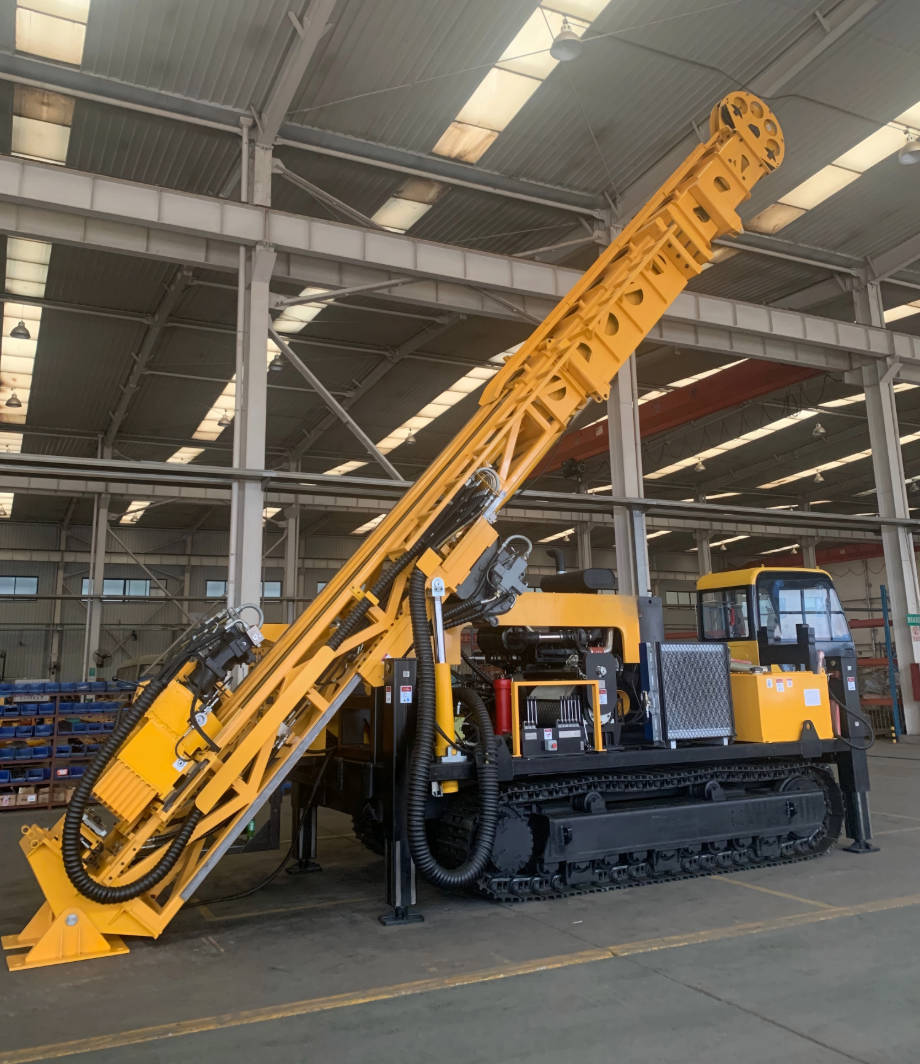
"360-degree drilling" can describe different machine movements. Buyers should distinguish between three capabilities:
- Turntable rotation: the positioning assembly rotates around an axis.
- Feed-frame inclination: the feed frame tilts to establish upward, horizontal, or downward holes.
- Combined positioning: the boom, turntable, and feed frame work together to reach different drilling directions.
A 360-degree turntable alone does not prove that a rig can drill every required hole from one setup. Tunnel walls, roof clearance, stabilizers, hoses, rod handling, and wireline access can all restrict the usable envelope.
Also, multidirectional positioning is not the same as directional drilling. The former establishes the initial hole direction; the latter involves controlling or changing the borehole trajectory after drilling begins.
The specification that matters most is the usable drilling envelope: the directions the fully equipped machine can actually drill at the proposed station.
Both machine categories can use hydraulic rotation, controlled feed, and wireline core recovery. Their main differences concern positioning, installation, access, and the surrounding work environment.
| Comparison factor | Underground diamond core drill | Surface diamond core rig |
|---|---|---|
| Typical starting point | Existing underground drill station | Prepared surface location |
| Primary application | Underground exploration and resource definition | Surface exploration and resource evaluation |
| Positioning priority | Multiple orientations within restricted space | Stable mast alignment and surface access |
| Hole directions | Upward, horizontal, and downward where configured | Commonly downward and inclined; other directions require verification |
| Installation constraints | Tunnel dimensions, ground support, service access | Pad size, ground conditions, roads, and environmental restrictions |
| Rod handling | Limited by chamber dimensions and handling envelope | Often more open space, depending on layout |
| Power considerations | Electrical supply, ventilation, and cooling | Diesel or electrical supply, depending on configuration |
| Capacity comparison | Must account for upward and downward ratings | Must account for rod size, angle, and configuration |
| Principal purchasing risk | Assuming compact dimensions guarantee full working clearance | Assuming surface access guarantees economical target access |
These are category-level distinctions, not universal specifications. A particular machine may cross application boundaries, but its installation and operating limits still require verification.

Underground exploration frequently starts from a restricted chamber or tunnel intersection. A suitable positioning system can establish several holes without relocating the complete rig.
This makes an underground wireline core drilling rig attractive for fan drilling, where multiple boreholes investigate different directions from one station.
However, transport dimensions are only part of the assessment. The machine must also provide clearance for:
- Feed-frame movement and locking.
- Rod insertion and removal.
- Core barrel and overshot handling.
- Operator access and emergency escape.
- Maintenance, hoses, and service connections.
My recommendation is to review a working-layout drawing before comparing machine footprints. A rig that fits through the tunnel may still be difficult to operate at the drilling station.
An upward-facing feed frame does not automatically create a complete up-hole drilling system.
Upward drilling changes how gravity affects rods, inner tubes, and recovery equipment. Tooling must be appropriate for the hole orientation, including compatible pump-in and controlled-recovery arrangements where required.
Buyers should request confirmation of:
1. Approved upward drilling configurations.
2. Rod restraint and holding arrangements.
3. Compatible core barrels and overshots.
4. Loading and retrieval procedures.
5. Orientation-specific operating limits.
These details deserve the same attention as torque and feed force.
A surface diamond core drilling rig allows exploration to begin without an existing underground drilling station.
This is a fundamental advantage during early-stage exploration. Establishing underground access solely to obtain a better drilling position may introduce development costs and scheduling requirements that outweigh the shorter boreholes.
Surface programs still require suitable access, permissions, site preparation, and environmental controls. Nevertheless, where workable drill locations exist above the target, surface drilling provides a direct exploration route.
Surface installations may offer more room for rod storage, support equipment, maintenance, and mechanized handling. These advantages depend on actual pad conditions, not simply the absence of a tunnel roof.
Capacity also remains model-specific. Some surface rigs target deep exploration, while others prioritize compact transport or modular installation.
A meaningful comparison must identify:
- Rod and core size.
- Planned hole depth and inclination.
- Rotation speed and available torque.
- Feed force and pullback capacity.
- Pump performance.
- Installed tooling and handling equipment.
Comparing two advertised maximum depths without these conditions can produce a misleading purchasing decision.
Accurately setting the collar angle does not guarantee that the borehole will maintain its planned trajectory.
Rock structure, tooling condition, drill-string behavior, and operating practice can affect deviation after drilling starts. Positioning controls establish the initial alignment; downhole surveying checks the developing trajectory.
For both underground and surface drilling, define the survey method, survey intervals, and acceptable deviation before mobilization.
Where useful, compare planned and surveyed hole paths alongside drilling records. This helps distinguish a setup problem from a formation-related or operating problem.
A single depth rating can hide important differences.
For example, published specifications for an established underground drill list different maximum capacities for vertical-up and vertical-down drilling under defined configurations. This illustrates why buyers should not apply one downward capacity figure to every direction.
Ask suppliers for capacity information covering the actual program:
- Upward, horizontal, or downward orientation.
- Proposed rod system and diameter.
- Standard or deep-hole configuration.
- Relevant operating assumptions.
Competitor specifications demonstrate the importance of orientation-specific ratings; they should never be treated as CORTECH performance data.
Penetration rate measures only one part of a wireline drilling cycle.
A practical assessment also considers positioning, rod handling, inner-tube recovery, core handling, maintenance, and unplanned delays.
Record these activities separately during a trial:
| Activity | Useful measurement |
|---|---|
| Station setup | Time from arrival to drilling readiness |
| Positioning | Time to establish and verify the next hole |
| Drilling | Metres advanced during active drilling |
| Core recovery | Time per completed recovery cycle |
| Handling | Rod and tooling handling time |
| Delays | Duration and recorded cause |
This produces a more useful productivity picture than comparing drilling speed alone.
Consider a hypothetical program containing twelve target intersections.
A surface plan requires twelve 500-metre holes, totaling 6,000 drilled metres. An underground alternative reaches the same targets with twelve 180-metre holes, totaling 2,160 metres.
The underground option requires 3,840 fewer drilled metres—a 64% reduction in planned footage. However, this is a geometric illustration, not a field result or a forecast of savings.
The underground plan may still require chamber preparation, service installation, ventilation support, and interference management with mine operations. The surface plan may require access roads, pads, longer holes, and rehabilitation.
Compare total program cost using:
Cost per accepted target intersection=Total program cost/Number of accepted target intersections
Define an "accepted" intersection beforehand. It should meet the project's requirements for target location, sample recovery, surveying, and geological usefulness.
This approach connects equipment selection to the exploration outcome rather than footage alone.

Prepare a collar schedule showing azimuth, inclination, depth, diameter, and target location. Identify which holes must be drilled from a shared station.
For underground work, document tunnel dimensions, station layout, ground conditions, and services. For surface work, document access, pad dimensions, bearing conditions, and site restrictions.
Ask for working-envelope drawings, capacity tables, and component details. Confirm whether figures describe the quoted machine or another configuration.
Verify that the rods, core barrels, overshots, winch, clamps, and handling system support every planned orientation.
Define measurable checks for positioning, emergency stops, guards, rod restraint, service access, and operational clearances. Have qualified site personnel review safety-critical requirements.
Where feasible, assess the proposed system under conditions representative of the project. Record setup, handling, drilling, recovery, and delays rather than relying on a short drilling demonstration.

CORTECH develops, manufactures, and supplies fully hydraulic wireline diamond core drilling equipment, including CORE SURFACE DRILL and CORE U/G DRILL solutions.
The appropriate starting point depends on the application:
- Consider an underground configuration when existing workings provide useful target access and the program requires multiple drilling orientations.
- Consider a surface configuration when targets are best accessed from ground level or suitable underground infrastructure is unavailable.
- Evaluate both approaches when target geometry, existing infrastructure, and program scale create a genuine choice.
No general comparison should replace a model-specific technical review. Confirm positioning range, depth capacity, up-hole suitability, handling arrangements, and service requirements for the exact machine being considered.
Send CORTECH your collar schedule, target depths, core sizes, station dimensions, power availability, and handling requirements. Request a configuration review supported by working-envelope drawings and orientation-specific capacity information before finalizing your equipment selection.
No. It is often better suited to multidirectional drilling in confined mine workings, but the required angles must fall within the installed machine's working envelope. Turntable rotation alone is insufficient evidence.
Some configurations may support these orientations. Buyers must verify the approved inclination range, stability, rod restraint, handling clearance, and compatible recovery equipment. A standard surface designation does not confirm suitability.
No. Hydraulic systems control functions such as rotation, feed, and positioning. Mechanical geometry, installation conditions, tooling, and operating procedures still determine the available drilling range.
Neither category guarantees better samples. Recovery depends on geology, tooling, operating parameters, fluid management, and handling practices. Compare sample results under representative conditions rather than assuming the installation location determines quality.
Provide target depth, rod and core sizes, hole orientations, geological conditions, access dimensions, available power and water, and handling requirements. Include the collar schedule and site drawings when available.
Confirm that the complete system—not just the feed frame—is approved for the intended orientation. Review capacity, rod restraint, pump-in tooling, recovery controls, and operating procedures with the supplier and qualified site personnel.
1. Epiroc. "Core Drilling Rigs: Underground and Surface Exploration." Manufacturer overview supporting the distinction between surface and underground rig families, installation options, rod handling, and drilling-data functions. [epiroc]
2. Epiroc. "Diamec Smart 6." Manufacturer specifications supporting multidirectional positioning, remote controls, optional rod handling, and configuration-specific upward and downward depth ratings. Figures relate to Epiroc equipment, not CORTECH products. [epiroc]
3. Epiroc, distributed by First Break. "Diamec Smart 6" product brochure. Technical information on the 360-degree turntable, positioning system, feed configurations, and underground installation considerations. [firstbreak.co]
4. Boart Longyear. "Boart Longyear Launches Roller Latch™ Quick Pump-In™ Overshot." January 10, 2022. Manufacturer information on tooling developed for underground and up-hole wireline recovery. [boartlongyear]
5. Boart Longyear. "When It Comes Down to the Wire." Technical article describing pump-in systems, latch indication, and controlled inner-tube recovery during up-hole coring. [boartlongyear]
6. Boart Longyear. "Rock Products | How to Reduce Drill-Hole Deviation." January 26, 2018. Industry guidance supporting the distinction between equipment selection and operating practices in managing borehole deviation. [boartlongyear]


