
Views: 214 Author: CORTECH Publish Time: 2026-10-21 Origin: Site


Content Menu
● Full Hydraulic Core Drill vs. Mechanical Rig: Key Differences
● How the Two Core Drilling Systems Work
>> Full Hydraulic Core Drill: Controlled Power Delivery
>> Mechanical Rig: Transmission-Based Drilling
● Precision Mineral Exploration: What Actually Determines Success?
>> Core Recovery Is Not the Same as Sample Quality
>> Feed, Rotation, and Flushing Must Work Together
>> Hydraulic Control Does Not Guarantee a Straight Hole
● Performance in Hard Rock and Fractured Ground
>> Broken, Weathered, and Variable Formations
● Surface Core Drilling vs. Underground Core Drilling
>> Selecting a Surface Exploration Rig
>> Selecting an Underground Core Drilling Rig
● Safety: Compare Exposure, Not Just Drive Type
● Maintenance and Reliability in Remote Exploration
>> Hydraulic Systems Need Cleanliness and Diagnostic Support
>> Mechanical Simplicity Must Be Assessed Locally
● Unique Insight: Compare Cost per Accepted Meter
● Practical Buying Guide: A Five-Step Acceptance Test
>> 1. Define the Geological Task
>> 2. Verify Capacity Under Relevant Conditions
>> 3. Test Control and Measurement
>> 4. Observe a Complete Working Cycle
>> 5. Agree on Acceptance and Support
● Which Rig Should Your Exploration Project Choose?
>> 1. Is a full hydraulic core drill always more accurate than a mechanical rig?
>> 2. Can a mechanical rig use wireline core drilling tools?
>> 3. Does hydraulic drilling guarantee higher core recovery?
>> 4. What should buyers compare besides maximum drilling depth?
>> 5. Are full hydraulic core drills suitable for underground exploration?
>> 6. How can buyers verify a supplier's productivity claims?
A full hydraulic core drill and a mechanical rig can both recover valuable geological samples. However, they offer different approaches to controlling rotation, feed force, and drilling operations. For exploration teams comparing a full hydraulic core drill vs. mechanical rig, the central question is not simply which machine drills faster. It is which system delivers usable core consistently, safely, and at an acceptable total cost.
At CORTECH, our focus is developing, manufacturing, and supplying fully hydraulic wireline diamond core drilling rigs for surface and underground exploration. From a manufacturer's perspective, the strongest equipment recommendation starts with geology, target depth, site constraints, and sample-quality requirements—not a universal claim that one design always wins.

"Full hydraulic" generally describes a rig whose principal drilling functions use hydraulic power and control. A conventional mechanical rig typically relies more heavily on gearboxes, clutches, shafts, or related mechanical transmission arrangements.
The distinction is not absolute. Mechanical rigs may incorporate hydraulic feed, while hydraulic rigs still contain mechanical components. Buyers should compare actual configurations rather than labels.
| Comparison factor | Full hydraulic core drill | Conventional mechanical rig |
|---|---|---|
| Rotation control | Commonly offers continuously adjustable control within specified operating ranges | Often uses selectable gear ranges; adjustment depends on transmission design |
| Feed control | Hydraulic feed and holdback support controlled loading | Precision varies with feed mechanism and operator technique |
| Changing formations | Flexible adjustment can support rapid parameter changes | Response depends on controls and available speed ranges |
| Core recovery | Supports controlled drilling but cannot guarantee recovery | Can produce high-quality core with suitable tooling and operation |
| Maintenance | Requires hydraulic cleanliness, hose inspection, and fault diagnosis | Requires attention to gears, bearings, clutches, and lubrication |
| Handling systems | Remote controls and mechanized handling may be available | Handling arrangements vary; verify individual machines |
| Ownership economics | Additional control capability may justify greater system complexity | May be attractive where local repair capability and simplicity dominate |
A hydraulic system transfers power through pressurized fluid to motors and cylinders. In diamond core drilling, this architecture can support adjustable rotation, feed, holdback, and auxiliary functions.
Its practical advantage is controllability. When a drill bit crosses from competent rock into fractured ground, the operator needs to respond without imposing unnecessary load on the core or drill string.
However, hydraulic control is not synonymous with automation. Automatic feed regulation, parameter logging, remote operation, and rod handling are separate features that must be confirmed for the selected model.
A conventional mechanical rig transmits power through mechanical drive components. Depending on its configuration, it may offer several rotation speeds and a mechanical or hydraulic feed arrangement.
These machines can remain commercially sensible where crews understand the equipment, replacement parts are accessible, and drilling conditions suit the available operating ranges.
Calling every mechanical rig inaccurate would be misleading. Machine condition, spindle alignment, tooling, setup, and operator skill all affect performance.
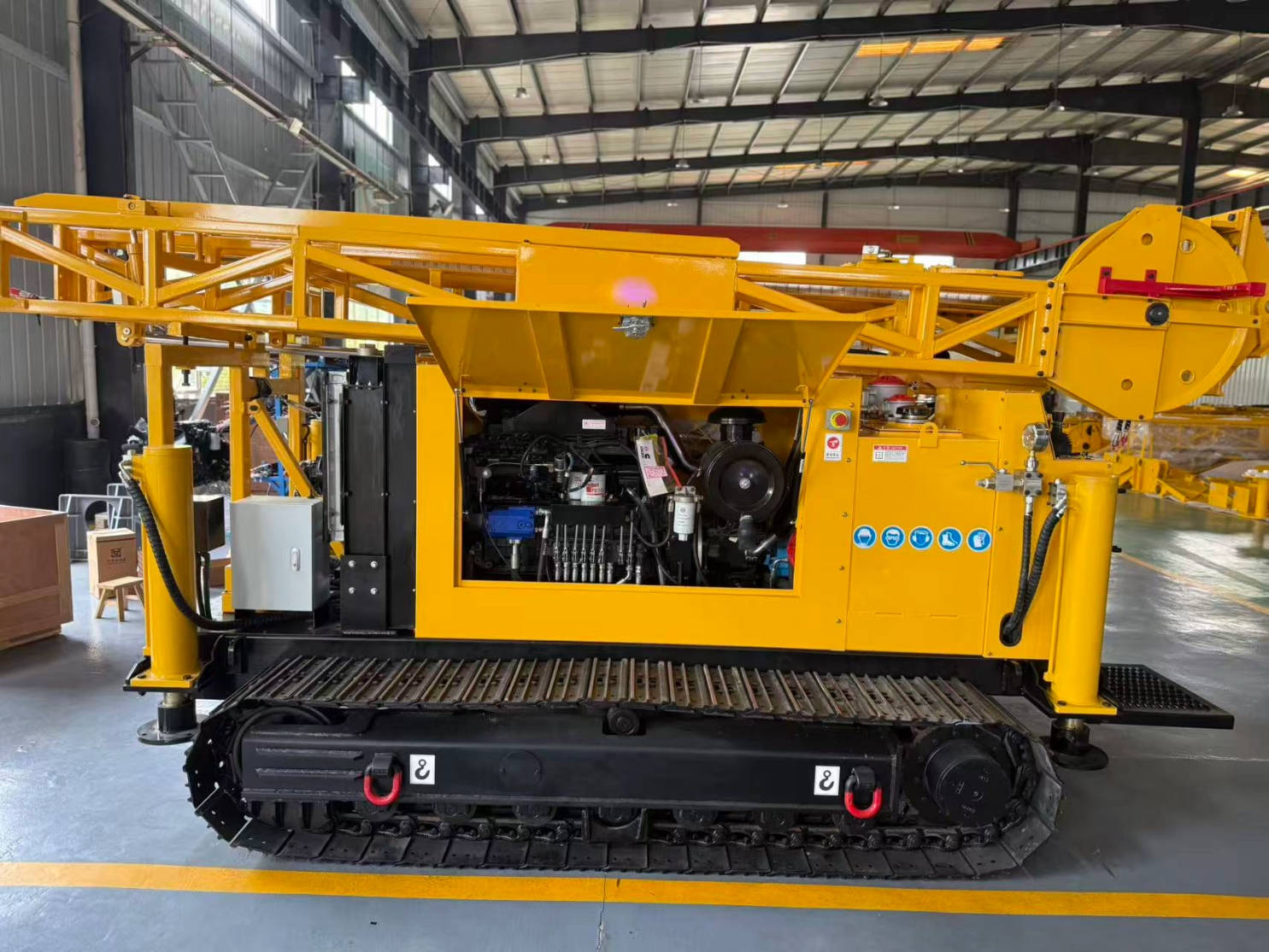
Core recovery measures the length of recovered core relative to the drilled interval. It does not, by itself, establish whether the sample preserves geological structures or represents the mineralized zone accurately.
A useful evaluation also considers:
- Preservation of fractures, contacts, and weak mineralized material.
- Sample washing or loss in broken formations.
- Accurate run depths and sample identification.
- Core orientation where structural interpretation requires it.
- Reliable handling and documentation after retrieval.
Neither drive architecture guarantees these outcomes.
Diamond drilling depends on the interaction between rotational speed, weight on bit, penetration rate, and flushing.
Boart Longyear's technical guidance explains that rotational speed influences penetration and that higher rotation or penetration rates can require additional fluid flow. It also describes determining bit force from hydraulic pressure differences.
The lesson for equipment selection is straightforward: assess how reliably the rig lets operators establish and maintain suitable parameters.
Hydraulic feed pressure should not automatically be treated as a direct weight-on-bit reading. Interpretation depends on the circuit, cylinder geometry, rod weight, friction, and calibration.
Hole deviation also depends on geology, bedding, drill-string stiffness, bit selection, setup, and operating practice.
A controllable rig can help operators manage drilling conditions, but accurate collaring and suitable downhole surveys remain essential. Where trajectory is critical, include survey requirements in the drilling plan rather than expecting the power system to solve deviation alone.
In competent rock, both rig types can perform well when matched with suitable diamond bits and operating parameters.
The relevant questions include:
- Does the machine provide appropriate rotation at the required torque?
- Can it maintain controlled bit loading?
- Is flushing capacity suitable for the hole and tooling?
- Does it retain adequate lifting capacity at planned depth?
Maximum torque and maximum rotational speed may occur at different operating points. Request performance curves rather than comparing isolated headline specifications.
Variable ground increases the importance of careful parameter adjustment and tooling selection.
A full hydraulic core drilling rig can provide useful control flexibility, but recovery may still depend on barrel configuration, run length, fluid management, and bit waterways.
Boart Longyear's bit-selection guidance identifies face-discharge designs that redirect fluid toward the bit face and reduce water pressure on the core. This illustrates why recovery improvements cannot be attributed to the rig alone.

For a surface diamond core drilling rig, evaluate the complete deployment:
- Access roads and transport restrictions.
- Ground-bearing conditions and rig leveling.
- Mast clearance and setup arrangements.
- Water supply and fluid containment.
- Rod storage and handling space.
- Mobilization between drill pads.
A crawler-mounted rig may simplify some site movements, while modular arrangements may suit restricted access. Neither eliminates the need for transport and setup planning.
CORTECH's CORE SURFACE DRILL offering should therefore be evaluated against the actual drilling program, including hole diameter, inclination, depth, and access conditions.
An underground core drilling rig faces different constraints: tunnel dimensions, installation space, drilling angles, services, and crew access.
Power-source selection also affects ventilation planning. Hydraulic actuation does not automatically mean electric power or zero local exhaust.
For CORTECH CORE U/G DRILL applications, provide tunnel dimensions, available electricity, cooling-water conditions, required drilling orientations, and handling clearances before requesting a configuration.
A hydraulic rig is not automatically safer than a mechanical rig. Safety depends on guarding, controls, maintenance, operating procedures, and the tasks workers perform near moving equipment.
Hydraulic systems also introduce pressurized-fluid hazards. Mechanical transmissions introduce their own rotating and moving-component hazards.
The strongest comparison asks how each configuration reduces exposure during:
1. Rod connection and disconnection.
2. Core-barrel retrieval.
3. Drill-string lifting and clamping.
4. Maintenance and stored-energy isolation.
5. Recovery from abnormal operating conditions.
Epiroc's core drilling equipment documentation identifies optional rod-handling systems that reduce manual handling and operator fatigue. The important procurement lesson is that these benefits belong to specific handling features—not automatically to every hydraulic machine.
Hydraulic performance depends on fluid condition, filtration, cooling, and component integrity.
Before procurement, clarify:
- Required fluid and filtration specifications.
- Inspection and replacement intervals.
- Hose protection and approved replacement requirements.
- Diagnostic procedures and technician training.
- Local availability of seals, filters, pumps, and valves.
A sophisticated rig becomes a liability if the project cannot support it.
A familiar mechanical machine may be easier for a particular crew to maintain. However, familiarity does not guarantee parts availability or low downtime.
Compare actual service networks, replacement lead times, workshop capability, and documentation. A locally supported hydraulic rig may be easier to maintain than an unfamiliar mechanical import.
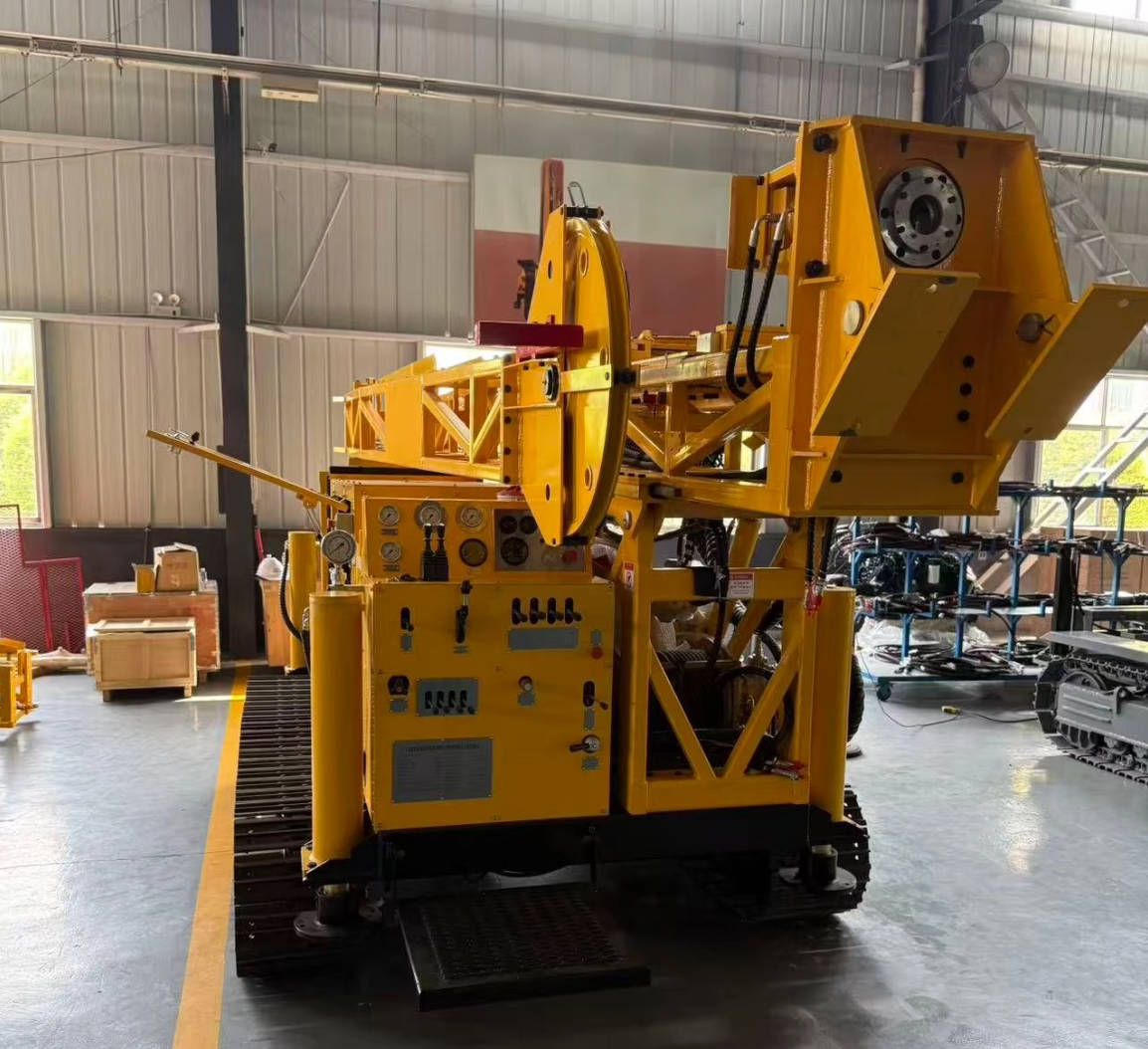
Purchase price is only one part of drilling economics. A more useful project measure is:
Cost per accepted meter = total campaign cost ÷ meters meeting agreed acceptance criteria.
Campaign cost should include mobilization, labor, fuel or electricity, consumables, maintenance, downtime, and any required redrilling.
Consider an illustrative comparison, not a field-performance claim:
| Campaign measure | Rig A | Rig B |
|---|---|---|
| Total campaign cost | $120,000 | $105,000 |
| Drilled meters | 2,000 | 2,000 |
| Accepted meters | 1,900 | 1,600 |
| Cost per accepted meter | $63.16 | $65.63 |
The less expensive campaign does not necessarily produce the lowest-cost geological information.
Define acceptance criteria before drilling. They should reflect the project's sampling objectives, not an arbitrary recovery percentage chosen after results are available.
Document expected formations, target depth, hole size, inclination, broken zones, and sample requirements.
Avoid requesting a rig recommendation based on depth alone.
Ask suppliers to explain the basis of depth ratings.
Confirm rod size, inclination assumptions, lifting capacity, torque-speed performance, and any operating limitations relevant to the proposed program.
During a demonstration, assess whether operators can adjust rotation and feed smoothly and interpret the instruments reliably.
If data recording is offered, confirm which parameters are measured directly, which are calculated, and how records are exported.
Do not evaluate only cutting speed.
Observe setup, drilling, core retrieval, rod handling, inspection, and preparation for the next run. Record delays and manual interventions.
Specify the commissioning process, training scope, spare-parts package, documentation, warranty conditions, and response arrangements.
If competing rigs undergo trials, keep tooling, ground conditions, and operating objectives as comparable as practicable.
A full hydraulic core drill is a strong candidate when the project prioritizes flexible parameter control, changing geological conditions, or integration with specified handling and monitoring systems.
A mechanical rig may remain appropriate when its capabilities match the geology and the operation benefits from established maintenance skills and dependable local support.
My recommendation is to choose the machine that performs the complete task—not the machine with the most impressive single specification.
For a project-specific assessment, send CORTECH your target depth, core size, geological conditions, drilling angles, surface or underground layout, and available site services. Request a configuration proposal covering operating capacity, tooling compatibility, handling options, maintenance requirements, and commissioning support.
No. Hydraulic control can support consistent parameter adjustment, but sampling quality and hole accuracy also depend on setup, geology, tooling, surveying, and operator practice.
Yes, where the rig configuration is compatible. Check spindle clearance, tooling dimensions, lifting capacity, and wireline arrangements. Wireline capability is not exclusive to hydraulic rigs.
No. Recovery depends on formation conditions, bit and barrel selection, flushing, run length, and operating technique. A hydraulic rig provides control capability, not a guaranteed recovery percentage.
Compare torque-speed performance, lifting capacity, feed control, tooling compatibility, transport dimensions, handling arrangements, maintenance support, and the assumptions behind the depth rating.
Purpose-designed underground hydraulic core rigs are available. Suitability depends on tunnel clearance, installation requirements, power supply, ventilation planning, drilling orientation, and safe operating space.
Request documented operating conditions and a representative trial. Compare complete drilling cycles and accepted sample output rather than penetration rate alone.
1. CORTECH. "Full Hydraulic Diamond Core Drilling Rigs Manufacturer." Manufacturer information supporting the company's surface and underground product scope; promotional performance claims are not treated here as independently verified results. [cortechdrilling]
2. Boart Longyear. "The Science of Drilling: Are You Getting the Most Out of Your Diamond Bits?" February 1, 2018. Technical guidance on rotational speed, bit force, hydraulic pressure interpretation, and flushing. [boartlongyear]
3. Boart Longyear. "Longyear Bits—Selecting the Right Bit in 5 Easy Steps." January 9, 2019. Guidance supporting the discussion of bit selection and fluid routing around the core. [boartlongyear]
4. Epiroc. "Core Drilling Rigs: Underground & Surface Exploration." Product information distinguishing hydraulic controls, electronic control systems, and optional rod handling. [epiroc]
5. Epiroc. "Surface Core Drilling Rod Handling System." Description of optional hands-free rod handling and its intended safety and fatigue-reduction benefits. [epiroc]
6. Boart Longyear. "Drill Control Interface—DCi." Product documentation illustrating available monitoring parameters and control functions; these features should not be assumed for every hydraulic rig. [boartlongyear]


