
Views: 222 Author: CORTECH Publish Time: 2026-05-02 Origin: Site


A rotary drilling rig can typically drill from several dozen meters for small foundation rigs up to several thousand meters for deep oil, gas and mineral exploration, depending on rig type, power, formation and borehole diameter. In modern mineral exploration, high‑capacity diamond core surface rigs such as CORTECH's all‑hydraulic CSD series are engineered to deliver core holes exceeding 1,000 m in depth with excellent core recovery and operational safety. [hwdrilling]
Rotary drilling rigs remove rock by rotating a drill bit while applying axial thrust, flushing cuttings out of the hole with drilling fluid or air. This method works in both soft and hard formations and is widely used for oil and gas, geothermal, water wells, foundations and mineral exploration. [hbxgdozer]
Depth capability is not a single fixed value; it is a function of rig design, installed power, hoisting capacity, borehole diameter and geology. For example, environmental and geotechnical rotary rigs often work in the 100–2,500 ft (30–750 m) range, whereas deep resource drilling can exceed 3,000 m with appropriately sized equipment. [cascade-env]

The following ranges are industry‑level references; individual models and manufacturers may exceed them with optimized designs and drilling programs. [linkedin]
| Rig type / application | Typical depth range | Typical hole size range |
|---|---|---|
| Small foundation rotary rigs | 15–70 m for piles and caissons hwdrilling | Up to 1.5–2.5 m diameter linkedin |
| Medium/large civil rotary rigs | 60–150 m for large‑diameter piles linkedin | Up to 2.5–4.6 m diameter linkedin |
| Water‑well rotary rigs | A few hundred to a few thousand feet hbxgdozer | 150–445 mm typical everstarmachinery |
| Environmental / geotechnical rotary rigs | Up to 2,200–3,500 ft (~670–1,070 m) cascade-env | 75–203 mm typical |
| Deep resource rotary rigs (oil, gas, geo) | Up to several miles (>3,000 m) hbxgdozer | 203–445 mm typical everstarmachinery |
| Diamond core surface drilling rigs (N/H/PQ) | 1,300–2,500 m core depth depending on size dutaborneomining.co | PQ, HQ, NQ core sizes dutaborneomining.co |
In practice, most mineral exploration and core drilling programs are optimized somewhere between hole depth, core size and project budget, rather than "maximum depth at any cost". As a result, an engineered match between rig and target depth is far more important than an absolute depth record. [everstarmachinery]
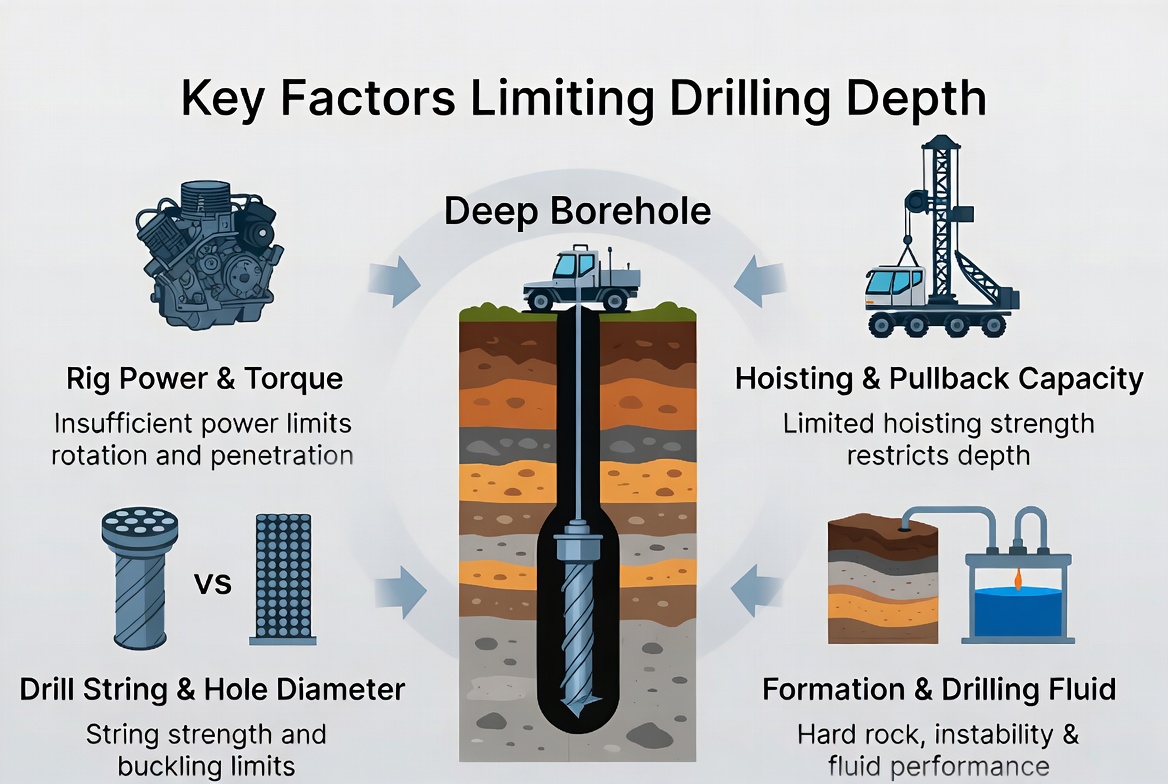
A rotary rig's installed power and rotary torque determine how efficiently it can rotate the bit under load at depth. Larger foundation rigs may offer 300 kW engines and 240–400 kN·m torque to drive large‑diameter tools, while exploration rigs trade some torque for higher rotation speed on smaller bits. [risenltd]
When power is insufficient, penetration rates fall sharply in hard formations and the risk of stalling or mechanical failure increases. As an expert drilling contractor, you would always check that the rig's torque–RPM envelope matches both the formation strength and the bit manufacturer's recommendations before committing to a target depth. [hbxgdozer]
As depth increases, the rig must hoist more drill string weight, plus bottom‑hole assembly and fluid. Modern core and multi‑purpose rigs can offer pull‑back capacities in the 17–18.5 t range or higher, which supports long strings of NQ, HQ or PQ rods at 1,000 m plus. [sanrock.com]
If hoisting capacity is marginal, tripping becomes slow and unsafe, and you may not be able to free stuck pipe or handle heavy coring assemblies at depth. For operators, this is one of the most practical limits to "how deep" a given rotary rig should work, regardless of theoretical torque and power. [cascade-env]
The deeper you drill at a given diameter, the heavier and more flexible the drill string becomes, which increases drag and the risk of buckling. That is why many deep holes taper from larger to smaller sizes, and why wireline diamond core systems (NQ, HQ, PQ) are standard for deep mineral exploration. [dutaborneomining.co]
For example, a surface core rig matched to BQ/NQ/HQ/PQ rods might offer depth ratings of 1,300 m (BQ), 1,000 m (NQ), 700 m (HQ) and 400 m (PQ). This demonstrates the basic rule: for the same machine, maximum depth falls as hole diameter increases. [sedsdrillingrigs.com]
Hard, abrasive formations, highly fractured intervals, swelling clays or high‑pressure water inflows all affect achievable depth. Good mud engineering or air/mist design is critical to stabilize the borehole, cool the bit and carry cuttings efficiently as the hole deepens. [gfzpublic.gfz]
In deep scientific and energy projects, rising formation temperature and pressure become additional constraints, which require specialized equipment and well design. For most surface core drilling projects, however, attention to fluid properties, bit selection and circulation rate is enough to reach planned depths safely. [gfzpublic.gfz]
From an industry practitioner's perspective, it is helpful to anchor theory in concrete field records. In environmental drilling, one major contractor reports rotary projects reaching about 2,200 ft and occasionally 3,000–3,500 ft, which they describe as unusual but feasible with the right rig package. [everstarmachinery]
In the broader drilling industry, advancements since the 1990s have pushed rotary systems to drill through both soft and hard formations down to about 3,000 m while maintaining bore diameters in the 203–445 mm range. Foundation rigs operating in civil construction commonly work to 70–150 m depth depending on torque and tooling, with bore diameters that can exceed 2.5 m for large piles. [hwdrilling]
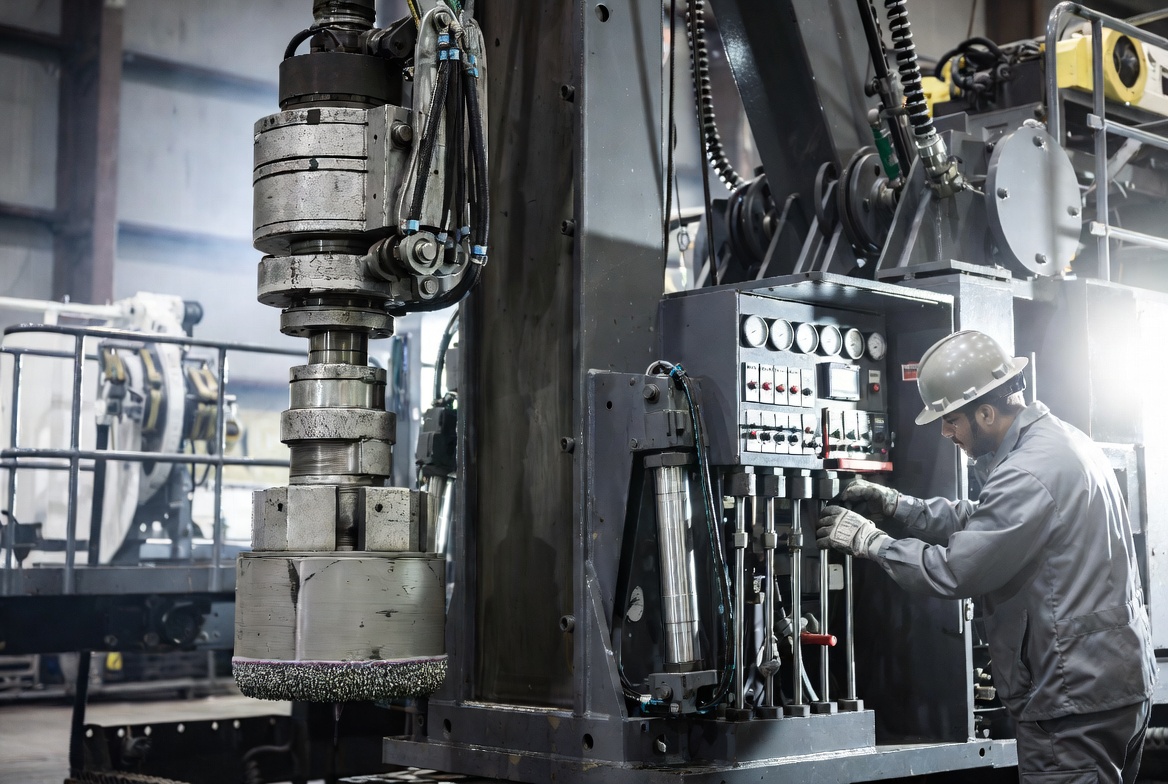
All‑hydraulic diamond core drilling rigs serve a specialized but highly demanding segment of the rotary drilling market: deep, accurate mineral and geological core holes. These machines use high‑speed rotation, wireline coring systems and carefully engineered hydraulic controls to deliver continuous, high‑quality core to depths well beyond 1,000 m in competent rock. [cortechdrilling]
For instance, a crawler‑mounted surface core rig designed for BQ–PQ rods can achieve nominal drilling depths of around 1,300 m (BQ), 1,000 m (NQ), 700 m (HQ) and 400 m (PQ). Multi‑purpose diamond rigs used by major contractors quote depth capacities up to roughly 2,491 m for NQ coring, illustrating how far modern core technology has extended realistic rotary depth limits for exploration projects. [foraco.com]
As a manufacturer dedicated to all‑hydraulic diamond core drilling rigs, CORTECH approaches the question "how deep can a rotary drilling rig drill?" from a performance and productivity perspective rather than chasing record depths. The company's focus is on ensuring that its surface and underground rigs deliver reliable, repeatable core recovery across long runs, not just theoretical depth ratings. [youtube]
CORTECH's CSD series surface rigs and related product lines are engineered around several key design principles: system efficiency, human‑centered operation, maintenance accessibility and safety at depth. By upgrading first‑generation products into a second generation with significantly improved hydraulics and control logic, the company has achieved overall performance that meets or surpasses advanced international levels for hydraulic core rigs. [cortechdrilling]
From a field user's standpoint, this means you can plan deep NQ or HQ core holes knowing that the rig's power‑train, hoisting system and hydraulic controls have been validated in demanding geological settings. The aim is not only to reach target depths, but to maintain good penetration rates and high core recovery while minimizing rig downtime and safety incidents. [youtube]
If you are evaluating whether a particular rotary or core rig can reach your planned depth, a structured approach helps. [hbxgdozer]
1. Define your target.
Clarify required final depth, core or hole diameter, and inclination, plus any expected pressure or temperature constraints. [cascade-env]
2. Review rig specifications.
Check rated drilling capacity by size (e.g. BQ/NQ/HQ/PQ), maximum pullback, rotary torque and engine power; compare these with your target depth. [linkedin]
3. Match drill string and tooling.
Select rods, wireline tools and bits appropriate to depth and geology, confirming that total string weight and torque requirements are within the rig's envelope. [journal25.magtechjournal]
4. Assess formation and fluids.
Use offset well data or past projects to anticipate formations, then design mud or air parameters to manage stability and cuttings transport at depth. [gfzpublic.gfz]
5. Build operational contingencies.
Plan for stuck pipe, loss circulation and bit failure; verify that the rig's hoisting and auxiliary systems can support fishing, reaming and conditioning operations. [everstarmachinery]
By working through these steps, a drilling engineer can move from the generic question "how deep can this rig drill?" to a project‑specific, defensible answer. This is the level of planning that professional operators use to protect safety, schedule and budget on deep rotary projects. [hbxgdozer]
Contact CORTECH's engineering team for a customized depth feasibility assessment for your project.
Q1: What is the maximum depth a standard rotary drilling rig can reach?
A standard land‑based rotary rig for resource projects can often reach several thousand feet, with some systems capable of drilling to or beyond 3,000 m depending on design and application. [cascade-env]
Q2: Why do manufacturers list different depths for different core sizes?
For the same rig, larger core sizes such as PQ use heavier, larger‑diameter rods, which increase string weight and drag, so the maximum rated depth is lower than for smaller sizes like NQ or BQ. [dutaborneomining.co]
Q3: How does formation hardness affect achievable depth?
Hard, abrasive rock slows penetration and increases bit wear, requiring more power and torque; if the rig is under‑powered, realistic maximum depth will be lower than in softer formations. [gfzpublic.gfz]
Q4: Can a foundation rotary pile rig be used for deep mineral exploration?
Foundation rigs are optimized for large‑diameter, relatively shallow piles and usually lack the rotation speed, wireline systems and depth‑optimized hoisting needed for deep core exploration work. [risenltd]
Q5: What advantages do all‑hydraulic core rigs offer at depth?
All‑hydraulic rigs deliver precise control, efficient power transmission and modern safety features, enabling high core recovery and reliable performance on deep NQ and HQ holes compared with older mechanical systems. [foraco.com]
1. HW Drilling – "How deep does a rotary pile driver usually drive?" [hwdrilling]
2. HBXG – "How Deep Can a Drilling Rig Drill" [hbxgdozer]
3. Cascade Environmental – "Common Questions About Rotary Drilling, Part 2" [cascade-env]
4. GFZ – "Drilling Into the Earth: How Deep Can We Go?" [gfzpublic.gfz]
5. LinkedIn – "The instruction of rotary drilling rig" [linkedin]
6. CORTECH Drilling Equipment Co., Ltd – Company profile and product overview [cortechdrilling]
7. YouTube – "High Capacity Diamond Core Surface drilling rigs – Cortech Drilling Equipment Co., Ltd" [youtube]
8. Everstar – "Rotary Drilling Rig: The Complete Guide (2025)" [everstarmachinery]
9. CORTECH CSD1300L core drilling rig specifications and descriptions [sedsdrillingrigs.com]
10. Sanrock – Wireline rope core drilling rig, 1,000 m depth specification [sanrock.com]
11. Foraco – Diamond / multi‑purpose drill rigs depth capacities [foraco.com]
12. Risen and other manufacturers – Rotary drilling rig torque, diameter and depth specifications [risenltd]


