
Views: 222 Author: CORTECH Publish Time: 2026-04-26 Origin: Site


Borehole drilling represents a precision-engineered process that creates narrow, cylindrical shafts penetrating the Earth's subsurface to access critical underground resources, conduct geological investigations, and support infrastructure development. As specialized manufacturers of full hydraulic wireline diamond core drilling rigs, we've witnessed firsthand how this fundamental technology enables industries worldwide to unlock subsurface resources safely, efficiently, and sustainably. [sinodrills]
Borehole drilling involves creating a vertical or angled cylindrical hole using specialized mechanical equipment that penetrates soil, rock, and various geological formations. The process requires sophisticated drilling rigs equipped with rotating or percussive mechanisms, drill bits designed for specific rock hardness levels, and fluid circulation systems that remove cuttings while stabilizing borehole walls. [en.wikipedia]
Modern borehole drilling operations integrate hydraulic power systems with advanced control mechanisms, delivering consistent torque and precise penetration rates across diverse geological conditions. The diameter of boreholes typically ranges from 110mm to 150mm for water wells, though mineral exploration applications may require different specifications depending on core sample requirements. [drilcorp]
From our manufacturing experience with CORTECH drilling equipment, we've observed that successful borehole drilling demands comprehensive site assessment, appropriate method selection, and quality equipment engineered to withstand demanding downhole environments. [miningdoc]

Borehole drilling establishes independent water supplies for residential, agricultural, and industrial applications, particularly critical in water-scarce regions. These systems access naturally filtered groundwater from underground aquifers, providing chemical-free water sources that reduce dependency on municipal infrastructure. [aziwell]
Diamond core drilling has revolutionized mineral exploration by enabling extraction of high-quality geological samples from depths exceeding 3,000 meters. Wireline core drilling technology, which we specialize in manufacturing, allows rapid core barrel retrieval without removing the entire drill string, reducing operational downtime by up to 40% compared to conventional methods. [boris-software]
The mining and petroleum industries rely extensively on borehole drilling to locate, evaluate, and extract valuable resources including metallic minerals, natural gas, and crude oil. Core samples obtained through diamond drilling provide essential structural, lithological, and mineralogical data that inform resource estimates and extraction strategies. [jeffreymachine]
Civil engineering projects require detailed subsurface data to assess ground stability, bearing capacity, and potential foundation challenges. Borehole drilling enables collection of undisturbed soil and rock samples that engineers analyze to design structurally sound foundations for buildings, bridges, and critical infrastructure. [ussaws]
Boreholes facilitate installation of ground-source heat pump systems that harness the Earth's stable subsurface temperature for sustainable heating and cooling. This renewable energy application reduces carbon emissions while providing cost-effective climate control for residential and commercial buildings. [sinodrills]
Environmental professionals utilize boreholes to collect groundwater and soil samples for contamination testing, enabling assessment of environmental health and remediation planning. Regulatory compliance often mandates borehole drilling for environmental impact assessments before major development projects proceed. [solmek]

| Drilling Method | Best Formation Type | Typical Depth Range | Key Advantages | Primary Applications |
|---|---|---|---|---|
| Rotary Drilling | Soft to medium-hard rock | 50-500 m | Versatile, efficient in varied formations | Water wells, oil/gas exploration (sinodrills) |
| DTH (Down-The-Hole) | Very hard rock formations | 100-1000 m | Superior penetration rates, excellent hole quality | Hard rock mining, geothermal (wontech-drill) |
| Wireline Core Drilling | All rock types | 200-3000 m | Rapid core retrieval, minimal downtime | Mineral exploration, geological surveys (miningdoc) |
| Cable Tool (Percussion) | Hard, fractured rock | 30-300 m | Reliable in challenging conditions | Small-scale water wells, rocky terrain (sinodrills) |
| Auger Drilling | Soft, cohesive soils | 10-50 m | Fast, simple operation | Shallow environmental sampling (sinodrills) |
| Reverse Circulation | Mixed formations | 100-500 m | Continuous accurate sampling | Mineral exploration, water wells (sinodrills) |
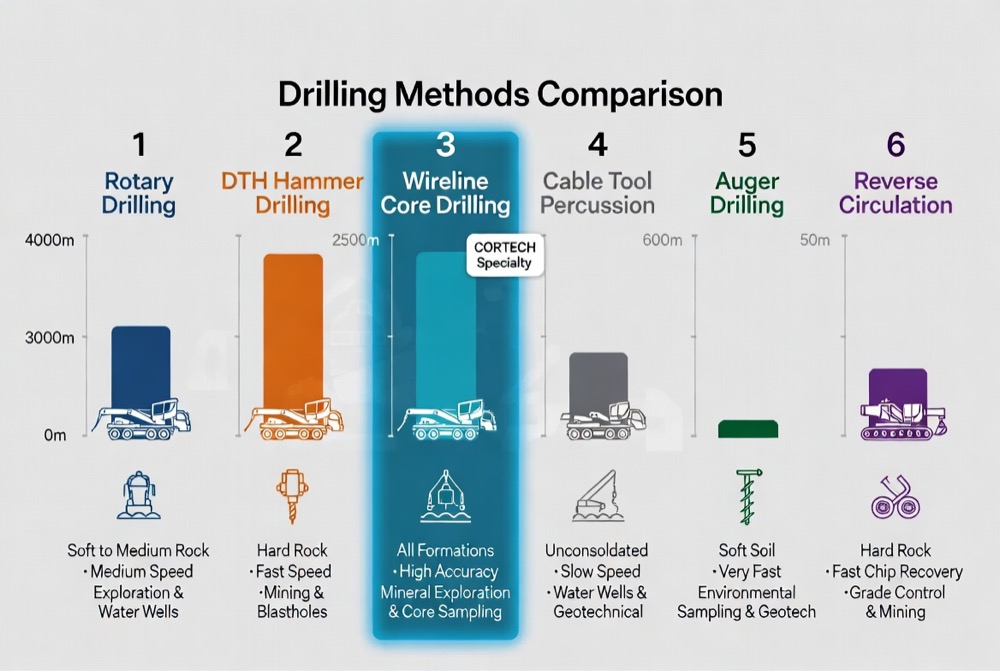
Rotary drilling employs continuous rotation of drill bits to penetrate formations, circulating drilling fluids that cool the bit, transport cuttings to surface, and stabilize borehole walls. This method proves most effective in sedimentary formations and medium-density rock, offering excellent versatility for water well installation and petroleum exploration applications. [ambwatertechnology]
As manufacturers specializing in full hydraulic wireline diamond core drilling rigs, we've engineered systems that revolutionize core sample retrieval. Wireline technology enables operators to extract core samples using a cable-suspended overshot tool lowered through the hollow drill string, retrieving the core barrel without removing drill rods. [massenzarigs]
This innovation delivers transformative efficiency gains: drilling operations beyond 300 meters depth previously required hours to trip the entire drill string for each core retrieval, whereas wireline systems complete the same operation in minutes. Modern wireline rigs effectively operate at depths reaching 1,000 meters and beyond, making them indispensable for deep mineral exploration and geological research. [miningdoc]

DTH drilling positions a pneumatic hammer directly behind the drill bit, delivering high-impact energy efficiently to fracture extremely hard rock formations. Compressed air powers the hammer mechanism while simultaneously flushing cuttings to surface, producing exceptional hole quality and penetration rates in granite, quartzite, and other crystalline rocks. [wontech-drill]
Modern drilling rigs integrate hydraulic power systems with precision control mechanisms, delivering adjustable torque, feed pressure, and rotation speed. Our CORTECH surface drill rigs feature truck-mounted mobility for efficient site-to-site transportation, while maintaining the structural capacity required for deep-hole drilling operations. [epiroc]
Full hydraulic systems offer superior advantages over mechanical or pneumatic alternatives: infinite speed adjustment, consistent performance across varying loads, reduced maintenance requirements, and enhanced operator safety through remote control capabilities. [songtemachine]
Polycrystalline Diamond Compact (PDC) bits utilize synthetic diamond cutters that shear rock rather than crushing it, producing intact core samples essential for accurate geological analysis. Diamond-impregnated bits maintain cutting efficiency through hundreds of meters of drilling in abrasive formations, delivering superior sample quality compared to conventional tungsten carbide alternatives. [coreplan]
The drill string assembly transmits rotational torque and feed pressure from surface to the cutting bit while providing conduits for drilling fluid circulation. Drill collars—thick-walled pipes positioned immediately above the bit—provide weight-on-bit and drilling stabilization, preventing deviation in deep holes. [sinodrills]
Engineered drilling fluids perform multiple critical functions: cooling and lubricating the drill bit, transporting rock cuttings to surface, stabilizing borehole walls through hydrostatic pressure, and preventing formation fluid influx. Modern formulations emphasize environmentally friendly, biodegradable additives that minimize contamination risks while maintaining operational effectiveness. [solmek]

Double casing installation involves placing a smaller-diameter inner casing within a larger outer casing, creating enhanced structural integrity in unstable formations. This technique proves essential when drilling through loose sand, gravel, or fractured rock zones that exhibit high collapse potential. [sinodrills]
The outer casing serves as a temporary or permanent protective barrier preventing wall cave-ins, while the inner casing protects the drill string and ensures the final borehole maintains long-term stability. This method significantly reduces project delays and cost overruns associated with borehole collapse incidents. [sinodrills]
Rock hardness, density, fracturing patterns, and permeability fundamentally determine which drilling methods can effectively penetrate specific formations. Unconsolidated sands require different approaches than massive granite, while fractured limestone presents unique challenges distinct from either extreme. [chongpomach]
The intended application—whether water well installation, mineral exploration, or geotechnical investigation—dictates required borehole depth, diameter, sample quality, and data collection methods. Mineral exploration demands intact core samples for assay analysis, whereas water well drilling prioritizes penetration rate and cost efficiency. [boris-software]
Budget constraints, timeline requirements, site accessibility, and equipment availability significantly influence method selection. Remote locations may necessitate portable drilling rigs with minimal support infrastructure, while urban sites might demand low-noise, low-vibration techniques to minimize disturbance. [songtemachine]
Regional regulations governing borehole drilling have become increasingly stringent, requiring environmental impact assessments, drilling permits, and adherence to best practices for fluid management and waste disposal. Selecting drilling methods and fluids that minimize ecological impact while meeting regulatory standards represents a non-negotiable project requirement. [dec.ny]
Proper casing selection ensures long-term borehole integrity and operational reliability. Industry-standard casing ranges include: [sinodrills]
- Range 1 (R1): 18-22 feet (5.5-6.7m) – Optimal for shallow wells and surface casing applications where lighter weight and easier handling provide operational advantages [sinodrills]
- Range 2 (R2): 27-30 feet (8.2-9.1m) – The most common specification, balancing reduced joint connections with manageable handling requirements for intermediate and production casing strings [sinodrills]
- Range 3 (R3): 38-45 feet (11.6-13.7m) – Engineered for deep well sections where minimizing threaded connections enhances structural integrity and reduces installation time, though requiring taller rigs for handling [sinodrills]
Manufacturing precision ensures each casing segment meets stringent industry standards for tensile strength, collapse resistance, and corrosion protection in aggressive downhole environments. [sinodrills]
Professional borehole drilling operations implement comprehensive safety management systems addressing mechanical hazards, ground instability risks, and environmental protection. Regular equipment inspection, operator training programs, and adherence to industry best practices minimize accident risks while optimizing drilling efficiency. [gefco]
Modern drilling rigs incorporate safety features including emergency shutdown systems, protective guarding on rotating components, and ergonomic operator stations that reduce fatigue-related incidents. Site-specific risk assessments identify potential hazards before drilling commences, enabling implementation of appropriate control measures. [songtemachine]
The drilling industry has made substantial progress in minimizing environmental impacts through technology innovation and operational improvements. Key sustainability initiatives include: [solmek]
Biodegradable drilling fluids that reduce soil and groundwater contamination risks while maintaining operational performance. These formulations break down naturally after use, eliminating long-term environmental persistence concerns associated with petroleum-based alternatives. [solmek]
Comprehensive waste management protocols ensure responsible disposal of drill cuttings, used fluids, and other byproducts. Many operations now implement closed-loop fluid systems that recycle and reuse drilling fluids, substantially reducing waste generation and disposal costs. [solmek]
Strategic site selection based on thorough environmental impact assessments minimizes ecological disruption by avoiding sensitive habitats, water sources, and areas with high conservation value. Careful planning reduces the overall footprint of drilling operations while facilitating site restoration after project completion. [solmek]
The global water well drilling equipment market demonstrates robust growth, projected to expand from USD 6.05 billion in 2025 to USD 8.41 billion by 2031. This growth reflects increasing water scarcity concerns, expanding mineral exploration activities, and infrastructure development in emerging economies. [finance.yahoo]
Technological advancements continue enhancing drilling efficiency and capabilities: automation systems reduce operator workload while improving precision, real-time monitoring technologies optimize drilling parameters for maximum penetration rates, and improved materials extend equipment service life in abrasive conditions. [wontech-drill]
Advanced drilling techniques including horizontal directional drilling have reduced project timeframes by up to 30% while requiring fewer resources and less manpower, delivering significant cost savings particularly in large-scale infrastructure projects. [chongpomach]
As specialized manufacturers of full hydraulic wireline diamond core drilling rigs, CORTECH delivers engineering excellence refined through decades of industry experience. Our surface drill rigs combine robust construction with advanced hydraulic control systems, enabling operators to achieve superior penetration rates, optimal core recovery, and extended service intervals in demanding geological conditions. [epiroc]
Every component we manufacture meets rigorous quality standards ensuring reliability in remote locations where equipment failure creates substantial operational and financial consequences. Our commitment to customer support extends beyond equipment delivery, providing technical training, maintenance guidance, and parts availability that maximize your drilling productivity and return on investment. [coreplan]
For mineral exploration, geological research, geotechnical investigation, or water well development applications, CORTECH drilling rigs deliver the performance, durability, and operational efficiency that professionals worldwide depend upon for successful project outcomes.
Q1: What is the typical depth range achievable with wireline core drilling rigs?
Modern wireline core drilling systems effectively operate from 200 meters to over 3,000 meters depth depending on rig specifications, geological conditions, and drilling parameters. Our CORTECH full hydraulic wireline rigs are engineered for deep exploration applications where conventional methods prove inefficient or economically unfeasible. [miningdoc]
Q2: How does diamond core drilling differ from conventional rotary drilling?
Diamond core drilling uses diamond-impregnated bits that cut and preserve intact cylindrical rock samples (cores) essential for geological analysis, whereas conventional rotary drilling crushes rock into small cuttings that are circulated to surface. Core drilling provides superior geological information but generally advances slower and costs more than conventional methods designed purely for hole creation. [boris-software]
Q3: What are the primary environmental concerns associated with borehole drilling?
Key environmental considerations include potential groundwater contamination from drilling fluids, surface disturbance during rig operation, waste disposal of drill cuttings and used fluids, and risks of creating pathways for contaminant migration between geological formations. Modern drilling practices employ biodegradable fluids, comprehensive waste management, and proper borehole sealing to minimize these impacts. [dec.ny]
Q4: Why is hydraulic power preferred over mechanical systems in modern drilling rigs?
Hydraulic systems deliver infinitely variable speed and torque control, maintain consistent performance under varying loads, require less maintenance than mechanical transmissions, and enable remote operation enhancing operator safety. These advantages translate directly into improved drilling efficiency, reduced downtime, and lower total operating costs over equipment lifetime. [songtemachine]
Q5: What factors determine the appropriate casing diameter for a borehole?
Casing diameter selection depends on the borehole's intended application, required flow rates for water wells, drill bit and core barrel sizes for exploration drilling, regulatory requirements, and future use considerations. Larger diameters provide higher flow capacity and easier maintenance access but increase drilling costs and complexity. [drilcorp]
Q6: How long does a typical borehole drilling project take to complete?
Project duration varies substantially based on target depth (ranging from days for shallow water wells to months for deep mineral exploration), geological conditions (hard rock drilling progresses slower than soft formations), drilling method efficiency, and equipment specifications. A 200-meter water well in favorable conditions might complete within 3-5 days, while a 1,500-meter exploration hole in hard rock could require 4-6 weeks. [ambwatertechnology]
Q7: What maintenance requirements do hydraulic drilling rigs have?
Regular maintenance includes hydraulic fluid analysis and replacement at specified intervals, filter changes, inspection of hoses and fittings for wear or damage, lubrication of moving components, and verification of safety systems functionality. Preventive maintenance programs substantially extend equipment service life while minimizing unexpected failures during drilling operations. [songtemachine]
1. Sinodrills - Borehole Drilling: What It Is and How It Works - https://www.sinodrills.com/borehole-drilling/
2. Aziwell - Borehole drilling: What is it, and how does it work? - https://www.aziwell.com/articles/borehole-drilling
3. Wikipedia - Borehole - https://en.wikipedia.org/wiki/Borehole
4. Drilcorp - What Is a Borehole? How Boreholes Work, Costs & Benefits - https://www.drilcorp.com/your-comprehensive-guide-to-boreholes/
5. Jeffrey Machine - An Exhaustive Guide to Borehole Drilling Methods - https://www.jeffreymachine.com/blog/an-exhaustive-guide-to-borehole-drilling
6. Epiroc - Core Drilling Rigs | Underground & Surface Exploration - https://www.epiroc.com/en-us/products/drill-rigs/exploration-drill-rigs/core-drilling-rigs
7. WonTech - 2026 DTH Drilling Guide: Methods, Tools & Applications - https://www.wontech-drill.com/blog/2026-dth-drilling-guide-methods-tools-applications
8. Yahoo Finance - Water Well Drilling Equipment Market Outlook 2026-2031 - https://finance.yahoo.com/news/water-well-drilling-equipment-market-121300301.html
9. Chongpo Machinery - 2026 Best Drill Earth Techniques for Construction Projects - https://www.chongpomach.com/blog/2026-best-drill-earth-techniques-construction-projects/
10. Mining Doc - What is wire-line core drilling? - https://www.miningdoc.tech/question/what-is-wire-line-core-drilling/
11. Boris Software - From Concept to Core: The Impact of Diamond Drilling - https://boris-software.com/from-concept-to-core-the-impact-of-diamond-drilling-on-efficient-exploration/
12. Songte Machine - Advantages of Portable Full Hydraulic Core Drilling Rigs - https://www.songtemachine.com/unleashing-mobility-and-efficiency-the-advantages-of-portable-full-hydraulic-core-drilling-rigs/
13. Solmek - Environmental Impact of Borehole Drilling - https://solmek.com/environmental-impact-of-borehole-drilling-what-you-need-to-know/
14. Massenza Rigs - Wireline core drilling for mining excavations - https://www.massenzarigs.com/wireline-coring/
15. CorePlan - Diamond drilling: What it is and why it matters - https://www.coreplan.io/blog/diamond-drilling-what-it-is-and-why-it-matters


