
Views: 219 Author: CORTECH Publish Time: 2026-11-12 Origin: Site


Content Menu
● Deep Diamond Core Drilling vs. Conventional Coring: How They Work
>> Deep Diamond Core Drilling With Wireline Retrieval
>> Conventional Coring With Full-String Retrieval
● Side-by-Side Comparison for Orebody Definition
● Geological Confidence: What Actually Improves Orebody Definition?
>> Core Recovery and Representative Sampling
>> Structural Data and Core Orientation
>> Hole Trajectory and True Thickness
● Productivity at Depth: Why Retrieval Time Matters
>> Compare Complete Cycles, Not Just Penetration Rates
>> Measure the Bottleneck Before Buying Capacity
● Core Preservation in Difficult Ground
>> Barrel Configuration Matters as Much as Retrieval Method
>> Adjust Operations Around Geological Risk
● An Illustrative Cost Model: Price the Information, Not Just the Meter
● A Five-Step Workflow for Selecting the Right Coring System
>> Step 1: Define the Geological Decision
>> Step 2: Separate Ground Conditions Into Domains
>> Step 3: Match Diameter to Sample Requirements
>> Step 4: Verify the Complete Drilling System
>> Step 5: Establish Acceptance and Review Criteria
● Where CORTECH Surface Core Drilling Rigs Fit
>> 1. Is Conventional Coring the Same as Reverse Circulation Drilling?
>> 2. Does Deep Diamond Core Drilling Always Use Wireline Retrieval?
>> 3. Does Wireline Coring Always Produce Better Core Recovery?
>> 4. When Can Conventional Coring Be the Better Choice?
>> 5. Can a Fully Hydraulic Rig Guarantee Resource Classification?
● Discuss Your Orebody Definition Program With CORTECH
Deep diamond core drilling vs. conventional coring is a comparison about more than drilling depth. For orebody definition, the real question is which system delivers reliable geological information at an acceptable cost, with manageable operational risk. From CORTECH's perspective as a manufacturer of fully hydraulic surface core drilling rigs, equipment selection should begin with the information the exploration team needs—not simply the number of meters planned.
An important distinction comes first: conventional coring can also use diamond bits. In this article, "deep diamond core drilling" refers to deep-hole diamond coring using wireline retrieval, while "conventional coring" means retrieving core by pulling the drill string and core barrel.
Both methods can produce valuable samples. Their practical differences become more significant as holes deepen, retrieval cycles lengthen, and geological uncertainty increases.
A diamond core bit cuts an annular path through rock, leaving a cylindrical sample inside the core barrel.
In a wireline system, an overshot retrieves the inner tube through the drill rods. The outer barrel and drill string normally remain downhole during routine core recovery. Full-string trips are still necessary for activities such as bit replacement or certain downhole problems.
This arrangement separates routine sample retrieval from full drill-string handling. Its principal advantage is reduced retrieval time, rather than an inherently different type of rock sample.
Conventional coring requires the rods and core barrel to be brought to the surface after each core run.
The method remains useful where holes are relatively shallow, suitable equipment is already available, or project conditions favor a conventional arrangement.
However, as depth increases, each retrieval involves more rod handling. Consequently, non-cutting time can become an increasingly important part of the drilling cycle.
Neither method automatically guarantees good recovery. Barrel design, ground conditions, drilling parameters, and operator decisions all matter.
| Evaluation factor | Deep wireline diamond coring | Conventional coring |
|---|---|---|
| Routine core retrieval | Inner tube recovered through the rods | Drill string and barrel withdrawn |
| Effect of increasing depth | Wireline travel increases, but routine rod trips are avoided | More rods must be handled during each retrieval |
| Geological information | Core for lithology, assays, structures, and testing | Can provide equivalent information when core quality is comparable |
| Core preservation | Appropriate barrel systems and controlled retrieval support preservation | Suitable barrels and careful handling can also preserve samples |
| Structural measurements | Compatible with appropriate core-orientation systems | Orientation depends on the equipment and procedures used |
| Operational demands | Requires maintained wireline components and trained crews | Requires repeated full-string handling |
| Cost assessment | Include retrieval savings, tooling, maintenance, and downtime | Include rod-handling time, labor, tooling, and downtime |
| Typical selection rationale | Deep programs with frequent core recovery | Shallow or specialized programs where full-string retrieval remains practical |
The comparison is not "high-quality core versus poor-quality core." It is primarily about how efficiently and consistently each system delivers the required evidence.
Orebody definition depends on understanding mineralized boundaries, grade distribution, alteration, and continuity.
Both methods can recover useful core. The critical question is whether recovered material adequately represents the interval drilled.
Missing core can create uncertainty, particularly where weak, fractured, or altered material contains mineralization. Loss should therefore be evaluated by geological domain and sampling interval—not hidden inside a project-wide recovery average.
Useful monitoring includes:
- Recovery for individual runs and assay intervals.
- The location of losses relative to mineralized contacts.
- Changes in recovery across different rock types.
- Relationships between recovery and reported grades.
- The likely geological character of unrecovered material.
High recovery is desirable, but it does not prove that sampling is unbiased.
For structurally controlled deposits, orientation can make core substantially more useful.
Properly oriented core helps geologists interpret the spatial relationships of veins, faults, foliation, and other features. That information can improve geological models and subsequent hole targeting.
However, wireline retrieval does not automatically produce oriented core. The program needs suitable orientation tools, reliable procedures, and documented confidence in the measurements.
Orientation becomes especially important where folded or faulted mineralization makes apparent thickness misleading.
A high-quality core sample still needs a reliable spatial position.
Collar coordinates, downhole surveys, and geological interpretations work together to locate mineralized intersections. The selected retrieval method does not eliminate the need for trajectory control.
Similarly, an interval measured along the core is not necessarily the orebody's true thickness. Geological geometry and intersection angle must be considered before making that interpretation.
For resource work, sample quality and positional confidence are complementary—not interchangeable.
Two systems may cut rock at similar instantaneous rates but produce different daily meterage.
A complete operating cycle includes:
1. Cutting the core run.
2. Stopping circulation and preparing for recovery.
3. Retrieving the sample.
4. Handling and documenting the core.
5. Returning equipment to working position.
6. Resuming drilling.
Wireline retrieval can shorten the recovery portion by avoiding routine full-string trips.
That advantage generally becomes more relevant as holes deepen. Nevertheless, actual results depend on core-run length, hole inclination, tooling condition, ground stability, and crew performance.
I would evaluate a deep-drilling proposal by asking where the shift actually goes.
If retrieval dominates, a better wireline arrangement may help. If the main losses come from unstable ground, fluid loss, bit changes, or maintenance, faster retrieval alone will not solve the problem.
Record time separately for:
- Productive drilling.
- Routine sample recovery.
- Bit changes and full-string trips.
- Hole conditioning.
- Repairs and maintenance.
- Waiting for water, supplies, or instructions.
This creates a defensible basis for equipment selection rather than relying on headline drilling speeds.
Wireline and conventional systems can both use barrel configurations intended to protect the sample.
Double-tube barrels separate the core from much of the rotating outer assembly and drilling-fluid flow. Triple-tube systems add a liner or split inner tube to support recovery and handling in suitable conditions.
These configurations can be useful in broken or weak formations, but selection must match the geological problem.
A retrieval system cannot compensate for an unsuitable barrel, excessive mechanical disturbance, or poor fluid management.
In difficult intervals, preserving information may justify shorter runs or revised operating parameters.
A practical response may include:
- Reviewing bit selection and operating settings.
- Adjusting circulation to balance cleaning and sample protection.
- Shortening runs where blocking or deterioration occurs.
- Changing barrel configuration when justified.
- Improving support through unstable sections.
These decisions should be made by qualified drilling and geological personnel. Increasing penetration rate is not a success if it destroys the evidence needed to interpret the deposit.
A quoted drilling rate is useful, but it does not capture the full economic comparison.
Consider the following hypothetical scenario. The figures demonstrate a calculation; they are not CORTECH performance results or industry benchmarks.
| Assumption | Conventional program | Wireline program |
|---|---|---|
| Total attributable program cost | $180,000 | $210,000 |
| Drilled length | 1,000 m | 1,200 m |
| Length accepted for the intended geological use | 800 m | 1,100 m |
| Cost per drilled meter | $180.00 | $175.00 |
| Cost per accepted meter | $225.00 | $190.91 |
Here, the higher-cost program produces a lower cost per accepted meter.
The lesson is not that wireline always wins. It is that procurement teams should define what counts as usable information before comparing proposals.
For this management metric, "accepted" should reflect documented project requirements. It must not become an arbitrary recovery threshold or replace professional geological judgment.
Other costs also matter: replacement holes, remobilization, delayed assays, and additional drilling needed to resolve uncertainty.
Identify what the drilling must establish.
Is the objective to locate a deep extension, constrain a fault, test continuity, collect metallurgical material, or support resource estimation?
Each objective places different demands on sample size, orientation, hole geometry, and recovery.
Avoid treating the deposit as one uniform drilling environment.
Map expected overburden, competent rock, fractured zones, alteration, and water-bearing intervals. Use existing logs and contractor experience where available.
Then identify where each domain may require different tooling or operating procedures.
Choose diameter around geological description, assay preparation, geotechnical work, testing, and retained reference material.
Larger core can provide more material, but it also changes equipment loads, consumable requirements, and achievable depth.
The smallest available diameter is not automatically the most economical choice.
Check the rig alongside the rods, barrels, winches, pumps, fluids, and handling equipment.
Review:
- Depth capability for the selected rod size.
- Pullback and hoisting requirements.
- Torque and rotation characteristics.
- Feed control.
- Wireline capacity.
- Site access and support requirements.
A depth rating alone is not a complete engineering assessment.
Before mobilization, agree on recovery reporting, survey requirements, orientation checks, sampling procedures, and analytical quality controls.
Review results early enough to change the program. Waiting until completion can turn a manageable sampling problem into an expensive information gap.
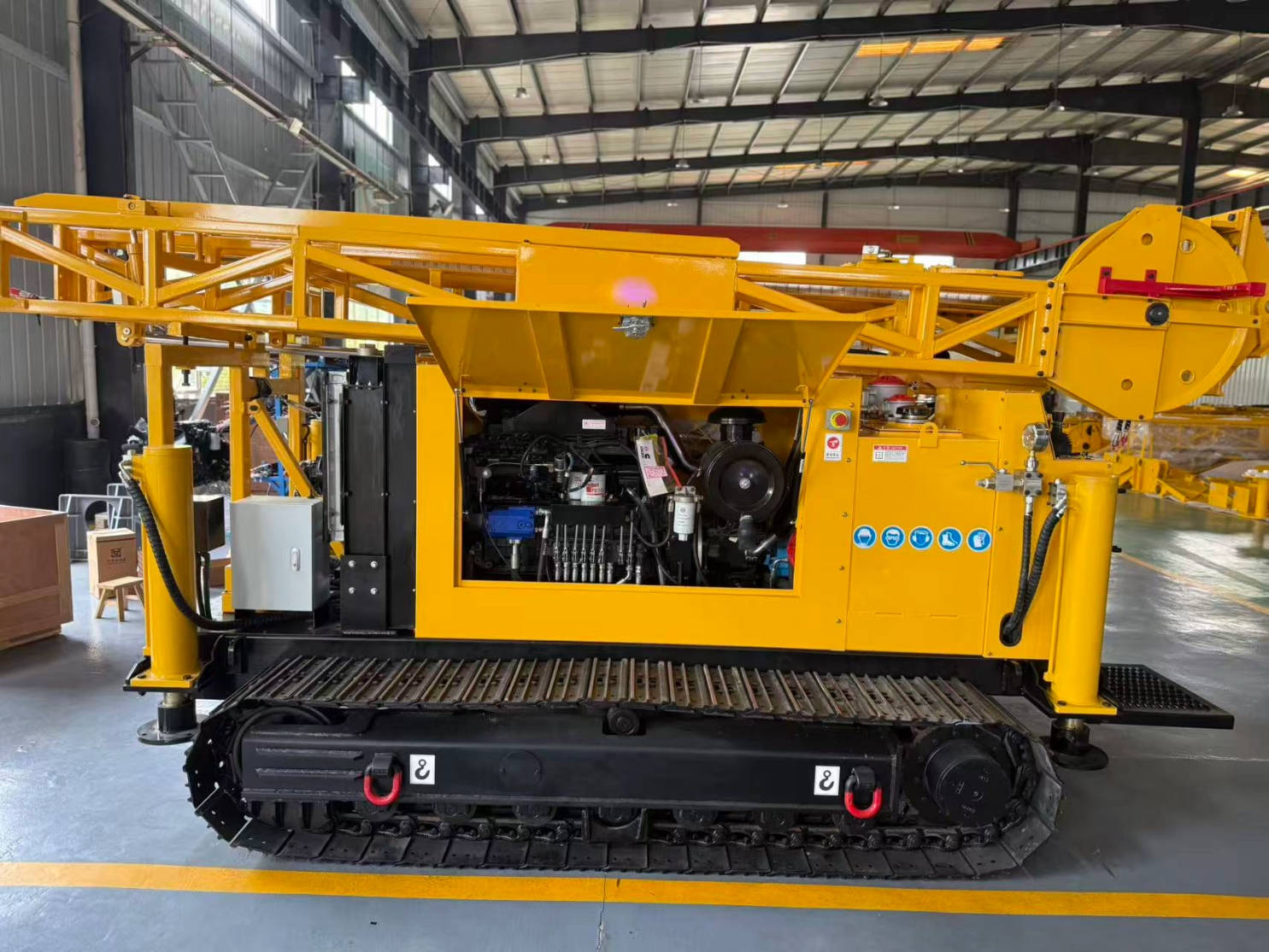
CORTECH develops fully hydraulic surface coring equipment for solid mineral exploration, including applications using diamond wireline coring.
For example, its published CSD1300L specifications list reference drilling capacities that vary with drill-pipe diameter: 1,300 m for B size, 1,000 m for N size, 700 m for H size, and 400 m for P size.
These are reference capacities, not promises for every formation or hole configuration.
The important purchasing lesson is the relationship between diameter and depth. A rig suitable for a deep, smaller-diameter hole may not meet a larger-diameter program at the same depth.
For CORTECH equipment selection, the discussion should therefore begin with the proposed hole design, required core, ground conditions, and operating constraints.
No. Conventional coring retrieves a cylindrical sample using a core barrel. Reverse circulation drilling generally produces chips. Comparing those methods introduces different sampling considerations from the retrieval-system comparison discussed here.
No. Diamond describes the cutting technology, while wireline describes the retrieval arrangement. This article focuses on wireline-equipped deep diamond coring because retrieval efficiency is central to the comparison.
No. Recovery depends on geology, barrel configuration, operating parameters, and handling. Wireline can support efficient retrieval, but it does not guarantee representative samples or eliminate losses.
It can be appropriate for shallow work, specialized sampling requirements, or projects where existing equipment and support make it practical. Compare the complete operating cycle rather than assuming one system is universally superior.
No. Resource classification depends on the geological evidence, data quality, continuity, estimation approach, and professional assessment. A drilling rig supplies part of the evidence; it does not determine the classification.
For deep orebody definition, wireline diamond coring often offers a compelling retrieval advantage. Conventional coring remains a valid option where project conditions support it.
Send CORTECH your target depth, required core diameter, hole inclination, expected formations, access constraints, and sample objectives. Request a configuration review covering the surface rig, tooling, retrieval system, and operating assumptions—not simply a maximum-depth quotation.
1. Canadian Institute of Mining, Metallurgy and Petroleum. CIM Mineral Exploration Best Practice Guidelines. Adopted November 23, 2018. Basis for drilling-method selection, representative sampling, core orientation, sample security, and analytical quality controls. [Read the guidelines]. [mrmr.cim]
2. Federal Highway Administration. Drilling and Sampling of Soil and Rock. Technical discussion of conventional and wireline retrieval, diamond bits, and core-barrel configurations. This engineering reference supports equipment mechanics rather than mineral-resource classification. [Read the technical document]. [pdhonline]
3. CORTECH. CSD1300L. Manufacturer's description and reference drilling capacities by drill-pipe diameter. Product specifications should be confirmed for the proposed configuration. [View the product specifications]. [en.cortech]
4. Pressacco, R. Overview of the 2018 Mineral Exploration Best Practice Guidelines. Presentation discussing mineralized-interval sampling, adjacent wall-rock sampling, and quality controls extending beyond assays. [Read the presentation]. [cimmes]


