
Views: 222 Author: CORTECH Publish Time: 2026-04-20 Origin: Site


Drilling a clean, accurate hole in rock is no longer just the job of giant rigs on remote job sites—it's something both DIY users and professionals can achieve with the right method, tools, and safety mindset. [youtube]
In this guide, I'll walk you through how to drill a hole in a rock step by step, drawing on real field experience from construction, mining and exploration projects, and highlighting where professional-grade core drilling tools such as diamond core bits, drill rods, and full hydraulic wireline systems dramatically improve speed, safety, and core quality. [concreteinsight.stck]

Drilling rock is more common than it sounds. You will typically need to drill rock in situations like: [youtube]
- Construction and infrastructure – anchor bolts, dowels, and reinforcement for buildings, tunnels, bridges, and retaining walls. [youtube]
- Mining and quarrying – blast holes, pilot holes, and exploration drill holes for ore bodies and aggregates. [pilebuck]
- Geological exploration and core sampling – obtaining intact cylindrical cores to evaluate lithology, structure, and ore grade. [massenzarigs]
- Water well and geothermal drilling – drilling through multiple rock layers to reach aquifers or geothermal reservoirs. [defusco]
- Landscaping and architecture – installing posts in bedrock, running utilities through stone, or creating water features and sculptures. [youtube]
- Artistic / jewelry projects – drilling small, precise holes in pebbles, gemstones, or slabs. [foredom]
Understanding your use case helps you choose the right drill type, bit, cooling method, and core drilling tool from the start. [concreteinsight]
This section adapts and upgrades the original Sinodrills process with additional safety, troubleshooting and expert tips. [youtube]
Before you switch on the drill, invest a few minutes in assessment and setup. [fridayparts]
1. Identify rock type and condition
- Hard, crystalline rock (granite, basalt): best with diamond or carbide bits and a powerful hammer or core drill. [rankingbit]
- Softer, sedimentary rock (limestone, sandstone): easier to penetrate but prone to chipping—use lower speed and careful cooling. [fridayparts]
2. Choose the right drill and bit
- DIY / light work: rotary hammer or hammer drill plus carbide masonry bit for shallow holes. [foredom]
- Professional or deep / critical holes: diamond core drill with appropriate core bit and drill rods; for deeper holes and core recovery, a hydraulic wireline diamond drilling rig is preferred. [concreteinsight.stck]
3. Mark and secure your work
- Mark the exact drilling point with a permanent marker. [youtube]
- For smooth or polished stone, place a small "X" of tape for traction. [fridayparts]
- Make sure the rock is stable—chock or clamp it so it cannot roll or vibrate. [youtube]
4. Wear full PPE
Always use: [concreteinsight]
- Safety glasses or face shield (flying chips).
- Work gloves (grip, vibration, abrasion).
- Hearing protection (hammer drills and rock drills are loud).
- Dust mask or respirator, especially when dry drilling.
5. Plan cooling and dust control
- Wet drilling with a controlled water supply is ideal for most rock and all diamond core drilling: it cools the bit, suppresses dust and improves bit life. [concreteinsight]
- If you must drill dry, use a dust extractor or vacuum and take frequent breaks. [concreteinsight]
> Expert tip: On deeper or high‑value holes, especially with diamond core bits, plan your flushing flow rate and water quality (clean, non‑abrasive water) to protect both bit and core. [epiroc]

A shaky start is one of the main reasons beginners crack stone or ruin bits. [foredom]
- Place the bit exactly on your mark, hold the drill with both hands, and start at low speed with light pressure. [foredom]
- If using a hammer drill on rock, engage the hammer function from the start, but keep RPM modest so the bit does not skate. [youtube]
- Once a small dimple forms, you can progressively increase speed and pressure. [youtube]
If the bit starts to wander:
- Stop drilling.
- Re‑seat the bit into the dimple and restart with slower speed and lighter feed. [youtube]
> Expert tip: For critical anchor or dowel holes on structural elements, use a drilling template or jig to maintain alignment, especially in overhead or inclined drilling. [defusco]
After establishing the starting hole, focus on maintaining a stable, efficient drilling rhythm. [concreteinsight]
- Maintain moderate speed and firm but not aggressive pressure—let the bit cut rather than forcing it. [concreteinsight.stck]
- Every few seconds, partially withdraw the bit to clear dust and cuttings. This reduces friction and the risk of binding. [concreteinsight.stck]
- If drilling wet, feed water steadily to create a thin slurry, not a flood. [fridayparts]
- Avoid side‑to‑side wobble, which can ovalize the hole and damage the bit or borehole wall. [youtube]
Signs you should pause and check the tool:
- The drill labors or stalls.
- The bit glows, smokes, or you smell burning.
- Penetration rate drops suddenly.
In these cases, stop, flush the hole, let the bit cool, and inspect cutting edges. [concreteinsight.stck]
Once you approach the target depth, reduce pressure and slow down. [youtube]
- Drill gently until the bit reaches the final depth. [youtube]
- Withdraw the bit while it is still rotating so debris clears and the walls stay clean. [youtube]
- Flush or vacuum remaining dust or slurry out of the hole. [concreteinsight]
If you require a larger diameter:
- Start with a pilot hole, then step up through 1–2 larger bit sizes, always using bits designed for rock. [defusco]
Finally, inspect:
- Hole diameter and roundness.
- Depth and straightness.
- Cleanliness if you are bonding anchors or epoxy. [concreteinsight]

The original Sinodrills article lists several drilling tools; here we reorganize them and add context so buyers can understand which tools fit which job. [concreteinsight.stck]
| Application / user type | Recommended tool type | Typical bit / system |
|---|---|---|
| DIY / light construction | Hammer drill / rotary hammer | Carbide masonry bits |
| Small precise holes in stone | Rotary tool / flexible shaft drill | Small diamond burrs and core bits |
| General construction in rock | Rotary hammer, top hammer drill | Retract drill bits, chisel bits |
| Deep blast / water wells / hard rock | DTH hammer system | DTH hammers, DTH drill pipes, DTH bits |
| Professional core sampling (shallow) | Diamond core drill, surface rigs | Diamond core bits, core barrels |
| Exploration & mining (deep core) | Wireline diamond core drilling rig | Wireline core barrels, drill rods, core bits |
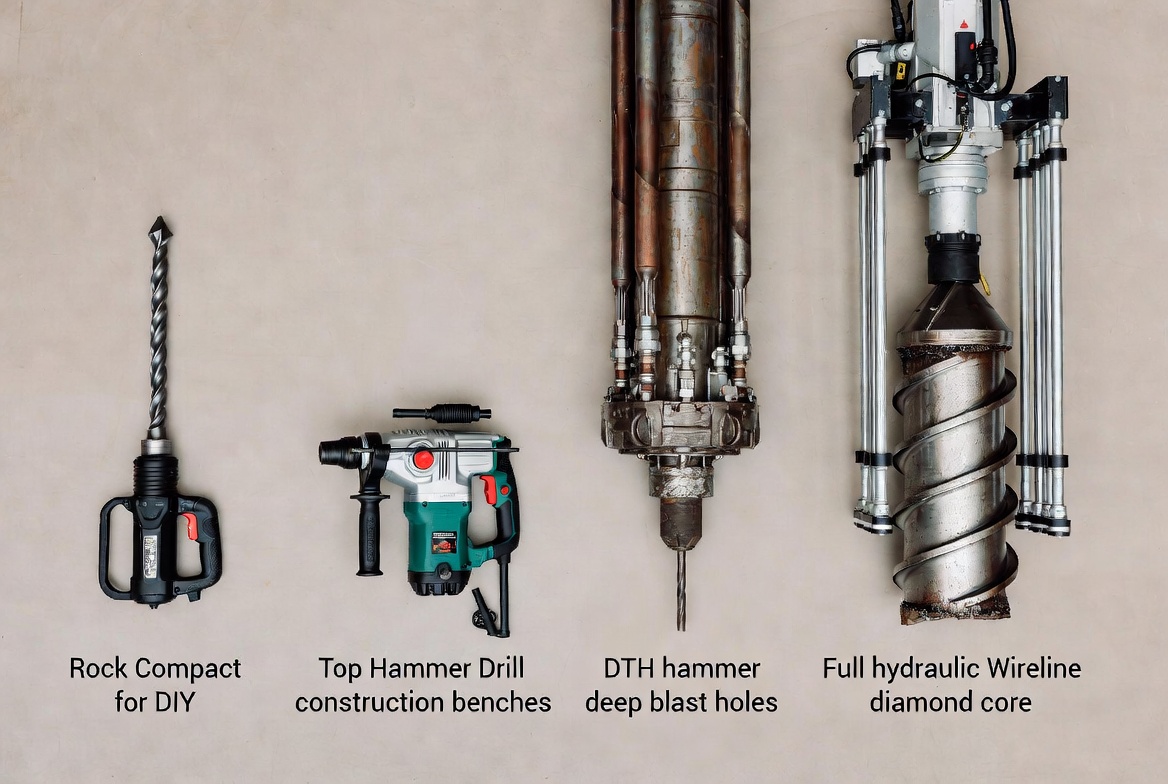
For small diameter holes and shallow depths, hammer drills and rotary hammer drills are the practical choice. [foredom]
- Combine rotation and percussion to chip away rock. [youtube]
- Use carbide‑tipped masonry bits for most rocks. [youtube]
- Suitable for anchors, small dowels, and light construction tasks. [youtube]
Rotary hammers with SDS or similar systems transfer impact energy more efficiently and are preferred for tougher materials. [youtube]
For more demanding construction and mining environments, top hammer drills and retract drill bits are widely used. [pilebuck]
- The hammer mechanism is at the top of the drill string; impacts travel down the drill steel to the bit. [pilebuck]
- Retract drill bits offer good penetration with back‑reaming capability, simplifying bit retrieval in fractured formations. [youtube]
- Ideal for medium‑depth holes in benches, tunnels and rock slopes. [pilebuck]
When you need deep, straight holes in hard rock, Down‑The‑Hole (DTH) hammer systems are a leading choice. [pilebuck]
- The hammer sits directly behind the DTH bit at the bottom of the hole, minimizing energy loss. [pilebuck]
- Powered by compressed air or hydraulic fluid, DTH hammers deliver a high‑frequency impact for fast penetration. [youtube]
- Associated components include:
- DTH drill pipes (standard and specialized designs). [youtube]
- Adapters (BOX‑to‑BOX, PIN‑to‑PIN, BOX‑to‑PIN). [youtube]
- GSE DHD DTH bits optimized for specific rigs and formations. [youtube]
DTH is common for blast holes, water wells, and foundation piles in tough rock. [pilebuck]
If you need clean, accurate cylindrical holes—or physical cores for analysis—diamond core drilling is the gold standard. [cadrillers]
- Diamond segments grind the rock rather than chipping, producing smoother walls and intact cores. [concreteinsight.stck]
- Requires continuous water cooling to control temperature and remove slurry. [fridayparts]
- Used in:
- Structural openings in reinforced concrete. [defusco]
- Geological sampling and mineral exploration. [cadrillers]
- Laboratory material testing. [concreteinsight.stck]
For serious exploration work, diamond core drilling is typically performed using full hydraulic wireline diamond core drilling rigs with compatible core barrels and drill rods. [massenzarigs]
Wireline core drilling deserves special attention because it underpins modern mineral exploration. [massenzarigs]
In a wireline system:
- A string of core drill rods advances the hole. [massenzarigs]
- The core barrel sits at the bottom, inside the rods, and collects the rock core. [massenzarigs]
- When the barrel is full, the core is retrieved up the inside of the rods by a wireline (cable), without pulling out the entire rod string. [cadrillers]
Benefits include:
- Faster core recovery at depth (commonly up to 1000 m and beyond with appropriate tooling). [massenzarigs]
- Less wear and tear on surface equipment. [epiroc]
- Improved safety and productivity. [epiroc]
Wireline is the system of choice in professional mining, geotechnical, and deep exploration projects, where consistent core recovery, orientation, and minimal hole deviation are essential. [cadrillers]

Choosing the right tool for rock type and project can dramatically improve penetration and bit life. [rankingbit]
- Soft rock (e.g., shale, soft limestone)
- Suitable tools: top hammer, DTH, standard carbide or drag bits. [rankingbit]
- Strategy: lower WOB, avoid over‑drilling to prevent hole collapse. [pilebuck]
- Medium‑hard rock (e.g., dolomite, dense sandstone)
- Tools: high‑quality carbide bits, DTH, top hammer, or diamond depending on accuracy needs. [rankingbit]
- Strategy: balanced RPM and feed; maintain proper flushing. [epiroc]
- Hard rock (e.g., granite, basalt, quartzite)
- Tools: diamond bits, high‑performance DTH, or specialized hard‑rock drag bits. [rankingbit]
- Strategy: higher bit load but controlled RPM; reliable cooling and high‑flow flushing to keep the bit sharp. [epiroc]
> Expert note: Industry best practice is to adjust weight on bit (WOB), rotation speed (RPM) and flushing rate together to maintain an optimal rate of penetration without polishing or prematurely wearing the bit. [epiroc]
Even experienced operators run into the same few issues. Here's how to avoid and fix them. [concreteinsight]
1. Bit overheating and glazing
- Cause: Too high RPM, insufficient cooling, packed cuttings. [fridayparts]
- Fix: Reduce speed, increase water flow, clear hole more frequently, and check coolant quality. [epiroc]
2. Cracked or spalled rock around the hole
- Cause: Excessive impact near edges, using hammer mode where it is not appropriate, or starting too aggressively. [fridayparts]
- Fix: Start with lower impact, avoid drilling too close to edges, consider diamond bits in drill‑only mode for brittle stone. [foredom]
3. Slow penetration
- Cause: Wrong bit for rock type, worn cutting edges, insufficient WOB. [rankingbit]
- Fix: Select a bit matched to rock hardness, check and replace worn bits, adjust WOB following manufacturer parameters. [rankingbit]
4. Hole deviation
- Cause: Natural fractures, incorrect starting angle, flexible tooling. [massenzarigs]
- Fix: Use pilot holes, stiffer rods, appropriate guidance systems, and check alignment at shallow depth before committing to full bore. [defusco]
For light DIY work, a basic hammer drill and masonry bit will usually suffice. For industrial projects and exploration drilling, however, tool choice directly affects safety, time, and data quality. [concreteinsight.stck]
Professional operators choose high‑quality diamond core bits, robust drill rods, and full hydraulic wireline diamond rigs because they:
- Deliver higher penetration rates with lower overall cost per meter drilled. [epiroc]
- Provide continuous, high‑recovery core, critical for geological interpretation and resource estimation. [cadrillers]
- Reduce non‑productive time due to fewer stuck tools and faster core retrieval. [epiroc]
- Improve safety, as operators handle fewer heavy rod trips and spend less time over the borehole. [concreteinsight]
A manufacturer that focuses on R&D, manufacturing and sales of core drilling tools and full hydraulic wireline diamond drilling rigs can support customers from tool selection and project planning through to after‑sales service and training, which is increasingly important under modern ESG and safety expectations. [rankingbit]
Whether you are drilling a single hole in your garden boulder or managing a multi‑rig exploration campaign, success starts with the correct drilling method, bit, and support tools. [concreteinsight.stck]
If you:
- Need advice on matching rock type, drilling method, and bit design, or
- Are looking for wholesale rock drilling tools, including retract drill bits, DTH hammers and drill pipes, diamond core bits, core drill rods and full hydraulic wireline diamond drilling rigs,
you should contact a specialized core drilling tool manufacturer to discuss your project's depth, rock type, and performance targets. A short technical consultation upfront often saves many hours—and many bits—on site. [massenzarigs]
1. Can I drill a hole in a rock with a regular cordless drill?
You can drill small, shallow holes in softer rocks using a high‑quality carbide masonry bit, but progress will be slow and bit life limited; for harder rock or larger diameters, a hammer drill or core drill is strongly recommended. [foredom]
2. Do I always need to use water when drilling rock?
Wet drilling is strongly recommended for diamond core drilling and for most medium to hard rocks because it cools the bit, removes slurry, and reduces dust; dry drilling is possible with adequate dust extraction and intermittent cooling, but it will usually shorten bit life. [fridayparts]
3. What is the difference between DTH and top hammer drilling?
In DTH systems the hammer sits at the bottom of the hole behind the bit, which delivers more impact energy to the face and suits deep, straight holes; in top hammer systems the hammer is at the surface, transmitting blows through the drill string, making them effective for medium‑depth holes and versatile construction work. [pilebuck]
4. Why is wireline core drilling preferred for deep mineral exploration?
Wireline systems use inner core barrels that can be retrieved via cable without pulling the drill rods, which significantly speeds up core recovery, improves safety, and maintains better control over hole conditions at depths that can exceed hundreds of meters. [cadrillers]
5. How do I choose the right core bit for my rock?
Match the diamond grade and matrix hardness to rock abrasiveness and strength: harder, more abrasive rocks typically need tougher matrices and suitable diamond exposure, while softer rock can be drilled efficiently with more aggressive, faster‑cutting formulations—your tool supplier can recommend a bit series based on lithology and expected penetration rate. [rankingbit]
1. Sinodrills. "How to Drill a Hole in a Rock?" (accessed 2026). https://www.sinodrills.com/how-to-drill-a-hole-in-a-rock/ [youtube]
2. Foredom. "Drilling Holes in Stones: Tips and Tool Recommendations." 2024. https://www.foredom.net/2024/04/dilling-holes-in-stones-tips-and-tool-recommendations/ [foredom]
3. FridayParts. "How to Drill a Hole in a Rock: Various Stone Types Guide." 2025. https://www.fridayparts.com/blog/how-to-drill-a-hole-in-a-rock [fridayparts]
4. Concrete Insight. "The Ultimate Guide to Core Drilling: Techniques, Tools, and Best Practices." 2025. https://concreteinsight.stck.me/post/1114004/The-Ultimate-Guide-to-Core-Drilling-Techniques-Tools-and-Best-Practices [concreteinsight.stck]
5. Massenza Rigs. "Wireline core drilling for mining excavations and research." 2026. https://www.massenzarigs.com/wireline-coring/ [massenzarigs]
6. Rankingbit. "钻探岩石:选择合适的工具." 2024. https://rankingbit.com/zh/drilling-rock-choosing-the-proper-tool/ [rankingbit]
7. CA Drillers. "5 Diamond Drilling Techniques for the Mining Industry." 2023. https://www.cadrillers.com/5-diamond-drilling-techniques-for-mining-industry/ [cadrillers]
8. Defusco. "How to Core Drill Concrete: Tools, Steps, Safety, Pro Tips." 2025. https://www.defusco.com/how-to-core-drill-concrete/ [defusco]
9. Pile Buck. "Mastering the Hard Rock: Effective Drilling Techniques and Technologies." 2024. https://pilebuck.com/mastering-hard-rock-effective-drilling-techniques-technologies/ [pilebuck]


