
Views: 285 Author: CORTECH Publish Time: 2026-09-19 Origin: Site


Content Menu
● Why Limited-Headroom Under-Bridge Drilling Is Different
● Portable Drilling Rig: Best for Tight Access and Flexible Deployment
>> Key Advantages of a Portable Drilling Rig
>> Portable Rig Limitations Under Bridges
>> When a Portable Drilling Rig Is the Better Choice
● Hydraulic Boring Rig: Higher Control, Capacity, and Consistency
>> Why Full-Hydraulic Control Matters
>> Hydraulic Boring Rig Limitations Under Bridges
● Portable Drilling Rig vs Hydraulic Boring Rig: Detailed Comparison
● The Real Constraint: Headroom Is More Than Mast Height
>> Practical Headroom Calculation Method
● Drilling Performance: Where Hydraulic Systems Usually Win
● Safety and Environmental Planning Under Bridges
>> Water and Slurry Management
● How to Choose the Right Rig Configuration
>> Choose a Portable Drilling Rig If:
>> Choose a Hydraulic Boring Rig If:
>> Choose a Low-Headroom Full-Hydraulic Core Rig If:
● Recommended Pre-Mobilization Checklist
● FAQ
>> 1. What is the main difference between a portable drilling rig and a hydraulic boring rig?
>> 2. Can a hydraulic boring rig work beneath a bridge with low headroom?
>> 3. Is a portable drilling rig suitable for diamond core drilling?
>> 4. Why is hydraulic feed control important in diamond drilling?
>> 5. What information should I provide when requesting a low-headroom drilling rig?
>> 6. What are the most important safety concerns for drilling beneath bridges?
>> 7. How can CORTECH help with under-bridge drilling projects?
For limited-headroom under-bridge infrastructure drilling, the right equipment decision is not simply about choosing the smallest machine. The practical comparison between a portable drilling rig and a hydraulic boring rig depends on available clearance, required hole diameter and depth, ground conditions, core-recovery requirements, reaction capacity, transport constraints, and the level of productivity needed on site.
From an equipment-manufacturer perspective, a portable system can be the most efficient choice when access is extremely restricted and the drilling objective is investigation, sampling, verification, or shallow-to-moderate coring. A full-hydraulic boring or diamond core drilling system becomes the stronger option when the project requires controlled feed, higher torque, deeper holes, reliable pullback, better core recovery, and repeatable performance in difficult ground conditions.
For bridge rehabilitation, foundation investigation, abutment assessment, pier inspection, seismic retrofitting, and utility-related drilling, the best solution is usually not the rig with the highest power rating. It is the rig package that delivers the required drilling performance within the actual headroom, footprint, load, safety, and logistics limits of the bridge environment.

Under-bridge drilling is a constrained engineering activity. A contractor may have enough horizontal room for equipment but insufficient vertical clearance for a conventional mast. In other projects, clearance is adequate but the access road, bridge deck loading limit, riverbank conditions, or lane-closure schedule restricts the size and weight of the drilling package.
These constraints make equipment selection more complicated than a standard surface drilling project.
Typical under-bridge drilling objectives include:
- Geotechnical investigation below bridge abutments or piers
- Diamond core drilling for bedrock characterization
- Concrete coring and structural verification
- Micropile or anchor-hole drilling for foundation strengthening
- Drainage and grouting investigation
- Sampling for environmental or contamination assessment
- Verification drilling during bridge widening or rehabilitation
- Rock socket investigation for new foundation construction
A bridge environment also raises the importance of stability, vibration control, safe rod handling, water containment, noise management, and emergency access. A drilling rig that performs well on an open exploration pad may not be suitable beneath a bridge if it cannot be safely positioned, anchored, assembled, or serviced.
Portable rigs and hydraulic boring rigs address these conditions differently.
A portable drilling rig is generally designed around mobility, compact dimensions, modular transport, and rapid setup. Depending on the design, the rig may be manually handled, skid-mounted, trailer-mounted, small-track-mounted, or powered by a separate hydraulic power pack.
Portable equipment is especially useful where a larger machine cannot reach the drilling location without major temporary works.
The main advantage is access. A portable drilling rig can often be transported through narrow pathways, down embankments, into confined areas near bridge abutments, or onto restricted work platforms.
Key benefits include:
- Compact transport dimensions for narrow access routes and restricted staging areas
- Lower mobilization burden when crane access is unavailable or expensive
- Modular configuration for difficult approach conditions
- Fast relocation between closely spaced investigation points
- Lower ground-pressure potential compared with larger tracked equipment
- Useful for shallow or moderate-depth geotechnical drilling
- Well suited to site investigation, sampling, and selective coring
- Can reduce the amount of temporary access construction
For extremely limited access, a portable system may be the only realistic equipment category that can physically reach the drilling point. Some compact rigs are designed for narrow corridors, low ceilings, underground access, and restricted work zones. Compact drill designs are widely used where low ceiling height and narrow working areas limit conventional drilling equipment.
The word "portable" should not be confused with "universally capable." A smaller rig may trade power, pullback, rod-handling efficiency, mast length, and drilling depth capacity for mobility.
Potential limitations include:
- Lower torque for difficult formations
- Reduced pullback or hoisting capacity
- More manual rod handling
- Slower drilling in hard rock
- Greater operator dependence
- Smaller fluid-management capability
- Reduced stability if the base is not properly anchored
- Limited capacity for larger-diameter holes or deep casing programs
- More frequent setup changes when drilling depth requires shorter rods
Under a bridge, short rods can help solve the vertical-clearance problem. However, more rod connections can slow the drilling cycle and increase handling exposure. The decision should be based on the entire drilling workflow, not only the rig's folded height.
Choose a portable drilling rig when the project has one or more of these conditions:
1. Very restricted access: The drilling location is inaccessible to a conventional crawler-mounted or truck-mounted drilling rig.
2. Low available headroom: The bridge soffit, utility lines, or structural beams prevent use of a standard mast.
3. Short-duration investigation work: The job requires multiple small-diameter holes, samples, or core verification rather than high-volume production drilling.
4. Sensitive ground conditions: The site cannot support heavy equipment without extensive temporary matting or ground improvement.
5. Limited mobilization window: A compact modular rig can be moved and assembled quickly during restricted lane closures or night shifts.
6. Remote bridge approaches: The drill site is reachable only by narrow trails, steep embankments, pedestrian access, or light-duty work platforms.
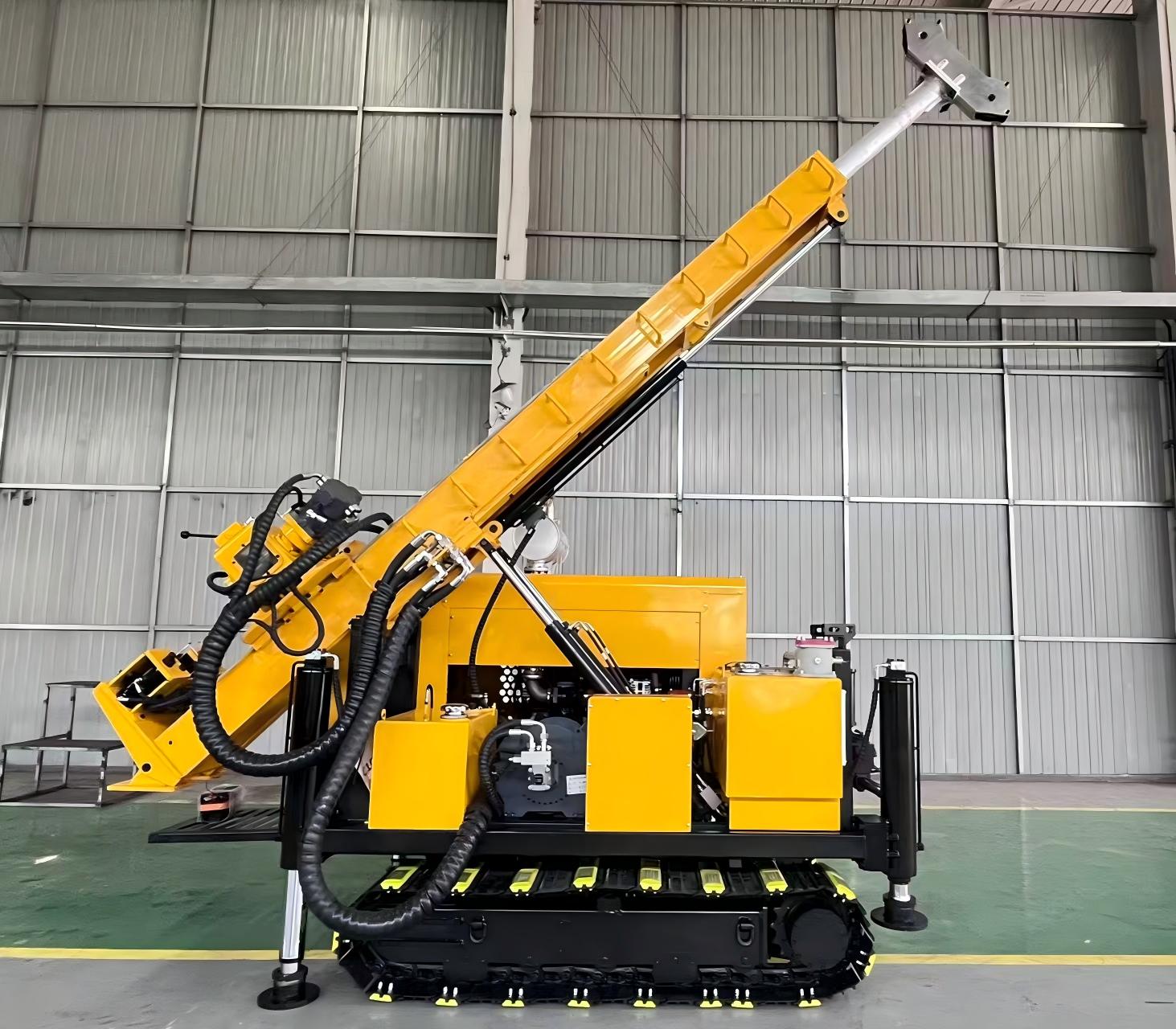
A hydraulic boring rig uses hydraulic power to control rotation, feed, pullback, clamping, hoisting, and other drilling functions. In under-bridge applications, this category can range from compact hydraulic core rigs to more substantial low-headroom drilling systems configured for difficult ground, deeper holes, or foundation-related drilling.
For a manufacturer such as CORTECH, a full-hydraulic diamond core drilling platform offers particular value when the project requires reliable and controlled rock coring rather than only access-driven drilling.
Hydraulic systems allow operators to regulate drilling parameters with greater consistency. In diamond core drilling, this matters because drilling success depends on managing the relationship among rotation speed, feed force, bit load, flushing performance, formation response, and core-barrel operation.
A well-matched full-hydraulic system can help the contractor achieve:
- Controlled feed pressure to reduce bit damage and excessive vibration
- Stable rotation in variable formations
- Higher pullback capacity for deeper holes and difficult drilling strings
- More predictable penetration performance
- Improved handling of wireline coring tools
- Better support for angled holes
- More efficient recovery operations
- Higher operational repeatability across shifts and crews
Diamond drilling guidance emphasizes that weight on bit, rotation speed, water flow, alignment, bit condition, and vibration control are critical to drilling performance and core quality. This is precisely where a properly designed hydraulic drilling system has an advantage over a minimally powered portable unit.
A hydraulic boring rig is not automatically the right answer. If it is too tall, too heavy, too wide, or too complex to mobilize, it can create more problems than it solves.
Common limitations include:
- Higher transport weight
- Greater setup requirements
- Need for adequate reaction or anchoring capacity
- More space required for hydraulic hoses, power pack, rod racks, and fluid systems
- Potentially higher initial equipment cost
- More demanding operator training
- Possible need for lifting equipment during mobilization
- Greater planning needs for fuel, hydraulic oil, and maintenance access
The key is not to compare a very small portable drill against a large conventional boring rig. For limited-headroom bridge work, the more relevant comparison is often a portable compact drill versus a low-profile full-hydraulic drilling rig engineered for constrained access.
| Selection Factor | Portable Drilling Rig | Hydraulic Boring Rig |
|---|---|---|
| Best use case | Restricted-access investigation, sampling, light coring, shallow-to-moderate holes | Controlled coring, deeper holes, hard rock, foundation investigation, demanding production work |
| Mobility | Excellent; often modular and easier to move manually or with light equipment | Moderate; depends on skid, crawler, trailer, or modular configuration |
| Headroom suitability | Strong when equipped with short mast and short rods | Strong only when specifically designed as a low-headroom hydraulic system |
| Torque and feed control | Often limited or less refined | Typically higher and more controllable |
| Pullback capacity | Lower to moderate | Moderate to high |
| Core quality potential | Suitable for basic sampling and smaller programs | Better for consistent diamond coring and high-quality geological data |
| Drilling depth potential | Usually limited by power, rod size, and manual handling efficiency | Better suited to deeper and more technically demanding holes |
| Rod handling | More manual work is common | Can support improved hydraulic clamping and handling options |
| Site setup speed | Usually faster for simple investigation jobs | Longer setup, but often more productive during extended drilling |
| Ground bearing requirements | Lower equipment weight may reduce site-preparation needs | May require stronger working platform and verified bearing capacity |
| Operator skill requirement | High in manual control and safe handling | High in hydraulic-system management and drilling parameter optimization |
| Best commercial value | Short programs where access is the dominant challenge | Projects where performance, depth, recovery, and schedule reliability matter most |
The table shows the central procurement principle: portable rigs solve access problems, while hydraulic boring rigs solve performance-control problems. A modern low-headroom hydraulic core rig can solve both, provided that the design matches the actual constraints of the bridge site.

A common equipment-selection mistake is to measure the clearance from ground level to the underside of the bridge and assume that the rig must simply be shorter than that number.
In reality, available operating headroom must account for:
- Drill mast or feed-frame height
- Drill rod length
- Rod breakout and connection space
- Top drive or rotary-head travel
- Hoist and wireline clearance
- Core-barrel retrieval space
- Operator standing and access room
- Protective guarding
- Overhead obstructions such as beams, pipes, utilities, and cross-bracing
- Ground settlement or temporary mat compression
- Allowance for safe rig movement and setup tolerances
A rig that nominally "fits" may still be unsafe or inefficient if the rotary head cannot complete its travel or if the crew cannot safely handle rods beneath the bridge structure.
Before selecting the drilling rig, measure and document the following:
1. Minimum clear vertical height at every proposed drill point, not only at the access entrance.
2. Working height after site preparation, including mats, steel plates, platforms, containment trays, and leveling blocks.
3. Required rod length, based on target depth, hole angle, and available handling space.
4. Mast travel and rotary-head clearance, including the full operating position.
5. Allowable safety margin, especially where structures are uneven, settlement is possible, or the work surface is not level.
6. Bridge obstruction map, identifying girders, diaphragms, drainage lines, electrical systems, utilities, and pier geometry.
7. Emergency extraction route for personnel and equipment.
Low-headroom drilling equipment is specifically developed for confined spaces, low-overhead work zones, and bridge-retrofitting environments. Equipment suppliers commonly emphasize mast-height configuration, compact footprints, and access compatibility as central selection factors.
When drilling reaches competent rock, fractured formations, alternating layers, weathered bedrock, or abrasive ground, the difference between portable and hydraulic systems becomes more visible.
A hydraulic boring rig can maintain more controlled drilling parameters. This reduces the temptation to force penetration with inconsistent feed pressure. In diamond core drilling, excessive force can contribute to poor bit life, vibration, deviation, damaged core, and lower-quality geological information.
A full-hydraulic diamond core drilling rig is especially valuable when the investigation requires:
- Continuous core recovery
- Wireline coring
- Oriented core
- Deep inclined holes
- Accurate geological logging
- Rock-quality designation assessment
- Reliable hole stability
- Repeated drilling over multiple shifts
- Consistent performance across changing formations
In my experience reviewing drilling equipment requirements, contractors frequently underestimate the value of controlled feed and pullback. They focus on rig transport weight or rated drilling depth, then discover that challenging ground demands better hydraulic response, a more stable feed frame, stronger clamping, and a more reliable fluid system.
For critical bridge projects, poor-quality core can create expensive downstream risk. If the geotechnical data does not accurately characterize bedrock, weathering, voids, fractures, or groundwater conditions, engineers may need additional drilling, redesign work, or conservative foundation assumptions.
Under-bridge drilling must be treated as a site-specific safety operation. The proximity of traffic, bridge structures, waterways, rail lines, utilities, and public areas increases planning requirements.
A complete under-bridge drilling plan should address:
- Rig anchoring and stability
- Verified ground bearing capacity
- Overhead clearance verification
- Utility and structural survey
- Traffic-control coordination
- Fall protection where required
- Emergency communication procedures
- Hydraulic-hose inspection and leak response
- Rotating-equipment guarding
- Safe rod-handling procedures
- Mud, water, and slurry containment
- Noise and dust management
- Lighting for night or enclosed-area work
- Fuel and fire-prevention measures
Construction rules also require safe separation from energized power lines when equipment operates near them. OSHA specifies minimum clearance requirements for equipment operations near power lines, including a 20-foot clearance option in applicable conditions.
Bridge drilling near waterways deserves special attention. Diamond drilling and boring operations often use water or drilling fluids for cooling, cuttings transport, hole cleaning, and bit performance.
The contractor should prepare:
- Secondary containment for fuel and hydraulic fluids
- Settling tanks or filtration equipment
- Closed-loop water-recycling systems where practical
- Spill kits near the drilling position
- Protected hose routing
- Controlled discharge procedures
- Site-specific environmental permits and inspection records
A compact rig does not eliminate environmental responsibility. In fact, limited space beneath a bridge can make fluid containment more difficult because hoses, tanks, rods, and crew movement compete for the same work area.
The best procurement decision comes from matching the drilling objective to a measurable equipment requirement.
- The location has severe access restrictions.
- The project requires small-diameter investigation holes.
- Transport and setup speed are more important than high drilling output.
- The target depth is moderate and formations are relatively manageable.
- The work area cannot support heavier equipment.
- The crew must move frequently between scattered test locations.
- Short-term inspection or sampling is the main goal.
- The project requires deeper holes or hard-rock drilling.
- High-quality diamond core recovery is essential.
- The hole program includes wireline coring or angled drilling.
- Consistent feed, torque, and pullback are needed.
- The project schedule depends on productive, repeatable drilling cycles.
- The drilling team expects changing or difficult ground conditions.
- The rig can be configured to meet headroom and access limitations.
- The project combines restricted clearance with demanding rock coring.
- Core quality directly influences foundation design or bridge rehabilitation decisions.
- The site requires compact dimensions but cannot compromise drilling control.
- Safety, stability, and long-term productivity are more important than the lowest initial equipment price.
- The contractor needs a scalable platform for bridge, tunnel, urban, and other constrained-access projects.
For CORTECH, this is the important market position: a compact, well-engineered full-hydraulic wireline diamond core drilling rig can bridge the gap between basic portability and serious drilling capability. It gives contractors an option beyond choosing either a lightweight but limited portable machine or an oversized conventional boring rig.

Before bringing any portable drilling rig or hydraulic boring rig under a bridge, complete this checklist:
1. Confirm the minimum headroom at each drill location.
2. Verify available working width, turning space, and transport route dimensions.
3. Confirm the bridge owner's access, traffic-control, and work-hour requirements.
4. Review structural drawings for utilities, drainage systems, diaphragms, and restricted areas.
5. Determine required drilling depth, hole diameter, inclination, and core-recovery standard.
6. Identify ground conditions, including fill, boulders, weathered rock, hard rock, groundwater, and contamination risk.
7. Calculate platform bearing capacity and determine whether mats, steel plates, or temporary works are required.
8. Select rod length and core-barrel configuration based on the measured clearance.
9. Plan slurry containment, water supply, return-water treatment, and spill response.
10. Confirm rig anchoring, operator access, lighting, ventilation, and emergency procedures.
11. Inspect all hydraulic hoses, fittings, guards, clamps, lifting points, and safety devices before drilling begins.
12. Prepare spare parts, drill bits, reaming shells, rods, consumables, and maintenance tools appropriate for the expected formation.
For limited-headroom under-bridge infrastructure drilling, a portable drilling rig is the smarter choice when access is the dominant obstacle and the drilling scope is relatively light, shallow, or investigation-focused. It provides flexibility, simpler transport, and lower mobilization demands.
A hydraulic boring rig is the stronger choice when the project requires deeper drilling, hard-rock penetration, better feed control, greater pullback, stable wireline coring, and more reliable core recovery. Its higher performance can reduce drilling uncertainty and support better engineering decisions.
For many modern bridge projects, the ideal solution is a low-headroom full-hydraulic diamond core drilling rig. This configuration combines compact access capability with the controlled hydraulic performance needed for professional geotechnical and structural investigation.
Need a drilling solution for a bridge, tunnel, slope, or restricted-access infrastructure project? Contact CORTECH with your required headroom, drilling depth, core size, ground condition, and access details. Our engineering team can help evaluate the most suitable full-hydraulic diamond core drilling rig configuration for your application.
A portable drilling rig prioritizes compact size, mobility, and access to restricted locations. A hydraulic boring rig prioritizes controlled drilling performance, higher torque, stronger pullback, and better suitability for demanding coring or deeper drilling programs.
Yes, but it must be configured specifically for the available clearance. The contractor must consider mast height, feed travel, rod length, rotary-head travel, core-barrel retrieval space, and safe operating clearance—not only the overall rig height.
Yes. Many portable rigs can perform diamond core drilling, particularly for shallow-to-moderate depth investigation. However, difficult rock, deeper holes, and high-quality wireline core recovery may require a more capable full-hydraulic core drilling system.
Hydraulic feed control helps operators maintain appropriate pressure on the bit. This can reduce vibration, avoid premature bit wear, improve penetration consistency, support better core recovery, and reduce the risk of damaging drilling tools or geological samples.
Provide minimum vertical clearance, working width, target depth, hole diameter, desired core size, drilling angle, expected geology, access route dimensions, ground-bearing capacity, available power and water, environmental restrictions, and the project schedule.
The main concerns include rig stability, overhead obstructions, traffic exposure, structural protection, utility clearance, power-line clearance, rod handling, hydraulic leaks, slurry containment, nighttime lighting, emergency access, and safe working-platform capacity.
CORTECH can support equipment selection for full-hydraulic wireline diamond core drilling applications by evaluating required drilling depth, core size, geological conditions, available clearance, mobility needs, and project logistics. A properly matched rig configuration can improve safety, core quality, drilling efficiency, and long-term equipment value.
1. Epiroc. "Diamond Driller's Technical Book." Guidance on diamond-bit operation, drilling parameters, water circulation, core-barrel alignment, vibration control, and drilling safety. [Read the technical book]
2. Epiroc. "Diamec 232 Brochure." Compact core drilling equipment information for narrow and low-ceiling work areas, including indicative drilling depth guidance. [View the brochure]
3. Occupational Safety and Health Administration. "29 CFR 1926.1408: Power Line Safety." Construction equipment clearance requirements and power-line safety requirements. [Read the OSHA standard]
4. National Piling Products. "Micro Drill Rigs." Limited-access drilling configurations, compact electric-hydraulic systems, and low-headroom mast options. [Explore micro drill rigs]
5. Hennessy International. "Limited Access Drilling Equipment." Overview of limited-access drilling equipment for low-clearance, bridge-retrofitting, tunnel, and confined-area drilling. [View limited-access equipment]
6. CORTECH Drilling. "How Multi-Rig Core Drilling Delivers Better Results." Equipment selection considerations involving target depth, formation, access, mobility, hydraulic power, safety, ergonomics, and technical support. [Read the CORTECH article]


