
Views: 262 Author: CORTECH Publish Time: 2026-09-18 Origin: Site


Content Menu
● Why Rig Selection Matters on Steep Slopes
● Small Drilling Rig Overview for Cliffside Work
>> Strengths of a Small Drilling Rig
>> Limitations of a Small Drilling Rig
● Heavy Hydraulic Drilling Rig Overview
>> Strengths of a Heavy Hydraulic Drilling Rig
>> Limitations of a Heavy Hydraulic Drilling Rig
● Small Rig vs Heavy Hydraulic Rig Comparison
● Access and Drill Pad Requirements
>> Expert Insight: The Rig Is Only as Safe as Its Platform
● Drilling Performance and Core Recovery
>> When a Small Drilling Rig Performs Well
>> When a Heavy Hydraulic Drilling Rig Performs Better
● Practical Rig-Selection Workflow
>> Step 1: Define the Geological Objective
>> Step 2: Establish the Required Depth and Hole Diameter
>> Step 3: Assess Access Before Selecting the Rig
>> Step 4: Build a Safety Margin Into Rig Capacity
>> Step 5: Compare Total Project Cost, Not Daily Rig Cost
● Safety Controls for Cliffside Drilling
● Which Rig Should You Choose?
● FAQ
>> 1. What is the main difference between a small drilling rig and a heavy hydraulic drilling rig?
>> 2. Can a small drilling rig be used for diamond core drilling on steep slopes?
>> 3. Is a heavy hydraulic drilling rig always better for deep core drilling?
>> 4. What should be checked before putting a drilling rig on a steep slope?
>> 5. Why is wireline coring important for steep-slope drilling?
>> 6. Can a compact drilling rig drill large-diameter HQ or PQ core?
>> 7. How can contractors reduce risk during cliffside drilling?
Choosing between a small drilling rig and a heavy hydraulic drilling rig is one of the most consequential decisions in cliffside and steep-slope surface drilling. The right choice affects not only drilling depth and production rate, but also site-access feasibility, crew safety, core quality, mobilization cost, and the reliability of geological data.
For mineral exploration, geotechnical investigation, slope-stability assessment, tunneling projects, hydropower development, and remote infrastructure surveys, the decision should never be based on rig size alone. The most suitable machine is the one that matches the slope geometry, access method, target depth, required core diameter, ground conditions, drilling angle, and support capacity of the working platform.
At CORTECH, we manufacture full-hydraulic wireline diamond core drilling rigs for challenging surface-drilling conditions. From compact and transportable systems to high-capacity hydraulic core rigs, the practical lesson is clear: a smaller rig can win the access challenge, while a heavier hydraulic rig can win the deep-hole productivity challenge—but only when the site is prepared to support it.

Cliffside and steep-slope drilling are fundamentally different from drilling on a flat, accessible exploration pad. On difficult terrain, the drilling contractor must solve three problems before the bit enters the ground:
- How will the rig reach the drill collar location?
- How will the rig, crew, rods, water, fuel, and consumables be safely supported?
- Can the selected rig deliver the required drilling performance without overloading the platform or access route?
A rig that is technically capable of reaching the target depth may still be the wrong choice if it cannot be transported safely to the drill site. Conversely, a highly portable drilling system may reach a remote ridge easily but become inefficient if the program requires large-diameter HQ or PQ core at significant depth.
In steep-slope surface drilling, equipment selection is a balance between mobility, stability, drilling capacity, and total project risk.
The decision is particularly important for:
- Mineral exploration drilling in mountainous terrain
- Slope-stability investigation
- Road, railway, bridge, and dam foundation studies
- Hydropower and tunneling geological surveys
- Landslide monitoring boreholes
- Remote geotechnical drilling programs
- Cliffside rock-mass characterization
- High-altitude exploration camps
A full-hydraulic diamond core drilling rig can provide smooth feed control, stable rotation, reliable pullback, and wireline coring efficiency. However, the weight, footprint, transport requirements, and anchoring needs must match the actual site conditions.
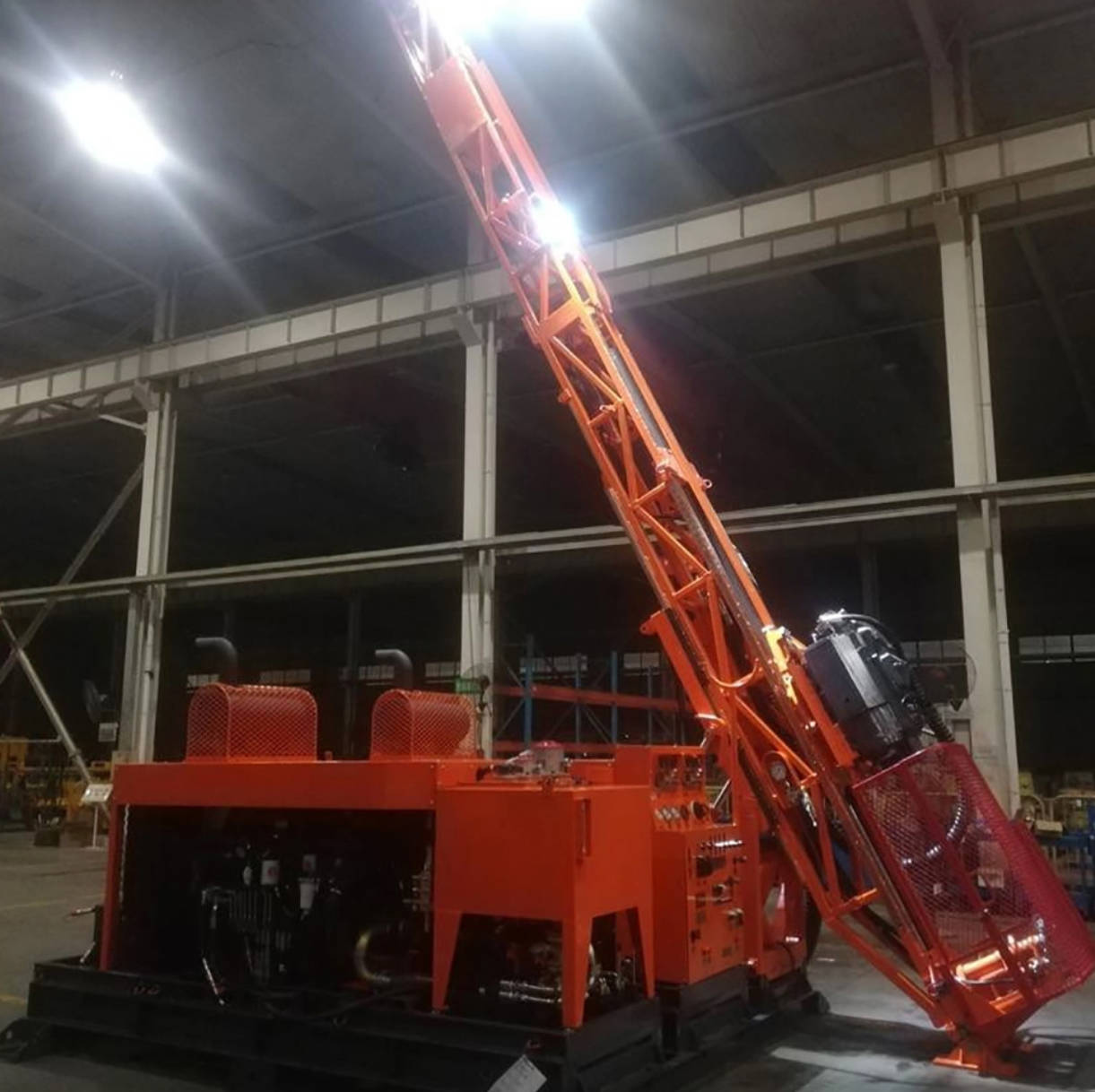
A small drilling rig is generally designed for easier transport, compact setup, lower site disturbance, and operation in areas where access roads are narrow, unstable, or unavailable. Depending on the configuration, it may be skid-mounted, modular, crawler-mounted, trailer-mounted, or heli-portable.
For steep terrain, the major benefit of a small drilling rig is not simply lower weight. It is the ability to divide the drilling system into manageable modules and move equipment through difficult terrain using manual handling, winches, cableways, tracked carriers, helicopters, or compact support vehicles.
A small drilling rig is often the better choice when the drilling site has limited access and the project requires fast relocation between scattered drill collars.
Key benefits include:
- Lower transport weight for mountain roads, forest tracks, and narrow benches
- Smaller working footprint on constrained drill pads
- Reduced pad-construction requirements
- Lower ground disturbance in environmentally sensitive areas
- Simpler relocation between multiple shallow-to-medium-depth holes
- Potential helicopter transportability when a heli-portable configuration is used
- Lower fuel consumption in many applications
- Easier deployment in remote exploration programs
A compact rig is especially valuable where the project team cannot safely bring a heavy crawler or truck-mounted machine to the collar location. It may also reduce the need for extensive road construction, which can be expensive and environmentally disruptive.
Small rigs are not automatically the low-risk option. Their limitations become important when drilling deeper holes, larger core sizes, highly fractured formations, or difficult directional angles.
Common limitations include:
- Lower available torque
- Lower pullback and feed force
- Smaller rod-handling capacity
- Limited hoist capacity
- Reduced onboard rod storage
- More frequent rod handling during deep drilling
- Lower productivity in large-diameter coring
- Potentially reduced capability in highly fractured or hard formations
- Greater dependence on disciplined operating practices
For example, a compact drilling rig may be ideal for a 200–500 m geotechnical hole in a restricted mountain location. However, if the program requires long HQ or PQ holes, aggressive drilling angles, deep wireline coring, or high-capacity casing work, a small rig may become slower and less economical over the full drilling campaign.
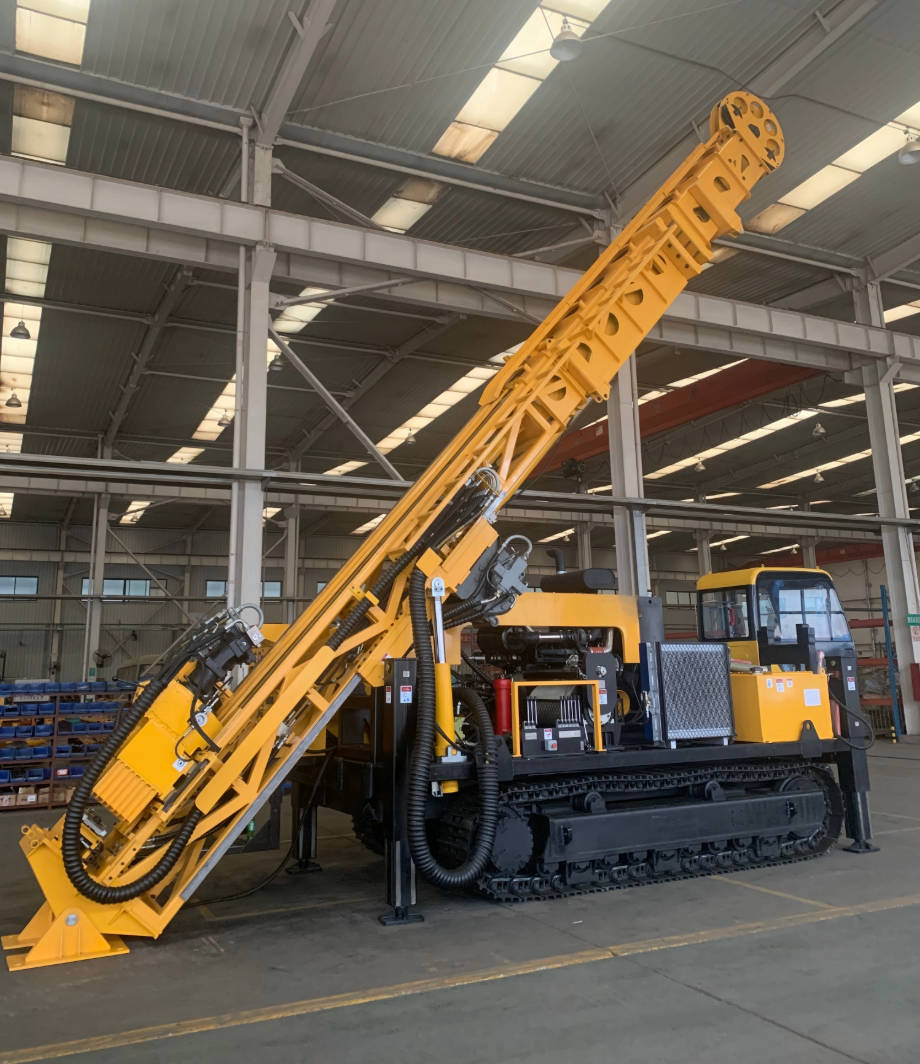
A heavy hydraulic drilling rig is built for demanding drilling programs that require higher torque, stronger pullback, larger hoists, deeper drilling capacity, greater rod-handling efficiency, and more stable control under sustained loads.
These machines are often crawler-mounted and use full-hydraulic transmission systems. They are commonly selected for deep mineral exploration, large-diameter core drilling, difficult formations, and projects where productivity per shift is a critical commercial factor.
A heavy hydraulic drilling rig can provide the power and control needed to drill consistently in hard rock, fractured zones, deep holes, and wireline coring programs where recovering core quickly is essential.
For suitable sites, a heavy hydraulic drilling rig delivers advantages that compact rigs cannot always match.
- Higher torque for difficult rock formations and larger-diameter drilling
- Greater pullback force for deep holes, casing, and difficult rod strings
- Higher feed force for controlled penetration in hard rock
- Larger mast and rod-handling capability
- Greater wireline winch capacity
- Improved deep-hole efficiency
- Better ability to support HQ, PQ, and larger drilling systems
- More onboard capacity for rods, tooling, pumps, and support equipment
- Higher production potential when the drill pad is properly engineered
In a full-hydraulic core drilling system, operators can control rotation, feed pressure, pullback, and winch functions with greater consistency. This matters in broken ground, where overly aggressive feed can damage the core, enlarge the borehole, cause rod vibration, or contribute to poor core recovery.
A heavy rig is not only about drilling faster. In the right conditions, it can create a more controlled and repeatable drilling process.
The main challenge is that drilling performance comes with greater logistical requirements.
Heavy hydraulic drilling rigs typically require:
- Wider and stronger access roads
- Larger, engineered drill pads
- Reliable slope drainage
- Strong anchoring and restraint systems
- Higher-capacity transport equipment
- More room for rods, mud systems, fuel, and crew movement
- Greater attention to ground bearing capacity
- More extensive site preparation before mobilization
A large crawler rig should never be placed on a steep or questionable platform simply because it has the drilling power to complete the hole. The slope, bench width, pad compaction, anchoring design, drainage, and rock-mass condition must be assessed first.
| Selection Factor | Small Drilling Rig | Heavy Hydraulic Drilling Rig |
|---|---|---|
| Primary advantage | Access to difficult or remote locations | Deep-hole capacity and high drilling productivity |
| Typical terrain fit | Narrow benches, remote ridges, steep access routes | Engineered drill pads with stable access |
| Transport method | Modular transport, skid, compact crawler, helicopter in some cases | Low-bed trailer, heavy transport, crawler access |
| Pad-size requirement | Smaller | Larger |
| Ground disturbance | Lower | Higher due to pad, access, and logistics needs |
| Drilling depth potential | Best for shallow to medium depths, depending on model | Best for medium to deep holes and demanding programs |
| Core diameter capability | Often more limited at deeper depths | Better support for HQ, PQ, and larger diameter programs |
| Pullback and torque | Lower to moderate | High |
| Deep-hole efficiency | Can decline as rod string length increases | Generally stronger and more consistent |
| Rod handling | More manual or semi-manual | Often more capable and efficient |
| Fuel consumption | Usually lower | Usually higher |
| Upfront mobilization cost | Often lower | Often higher |
| Suitable project type | Remote reconnaissance, slope investigation, scattered drill targets | Deep mineral exploration, large core programs, major geotechnical campaigns |
| Main risk | Under-capacity for deep or difficult holes | Overloading or destabilizing an inadequate drill pad |
The correct question is not, "Which rig is better?" The more useful question is:
Which drilling rig creates the lowest total project risk while meeting depth, core-quality, productivity, and safety requirements?
In cliffside drilling, access is often the decisive factor. A heavy hydraulic drilling rig may offer superior performance, but it becomes irrelevant if it cannot safely reach the drill collar location.
Before choosing the rig, the project team should evaluate:
1. Access route width and gradient
2. Turning radius for transport vehicles
3. Bridge and culvert load limits
4. Slope angle at the proposed drill site
5. Bench width and available working area
6. Ground bearing capacity
7. Rockfall and landslide exposure
8. Drainage conditions
9. Anchor locations for rig restraint
10. Emergency evacuation routes
A compact small drilling rig may allow the contractor to work from a narrow bench with limited preparation. This can reduce civil work and preserve the natural terrain. However, a small platform still requires proper leveling, anchoring, drainage, and exclusion zones.
For a heavy hydraulic drilling rig, pad design becomes more critical. The platform must support the static rig weight, dynamic drilling loads, rod-handling movements, crew activity, water tanks, mud systems, and support materials. A poorly designed pad can create unsafe movement, uneven mast alignment, loss of rig stability, or slope damage.
Experienced drillers know that a powerful rig cannot compensate for poor ground preparation. A stable pad, safe access route, engineered anchoring plan, and properly controlled water runoff often have a greater effect on safety than the difference between two rig models.
On steep slopes, platform quality is part of the drilling system.
For mineral exploration and geotechnical drilling, the value of the project depends on the quality of the recovered core. A rig that reaches target depth but produces damaged, washed, fragmented, or poorly documented core can compromise the entire investigation.
Both small drilling rigs and heavy hydraulic drilling rigs can use diamond wireline coring systems. The difference lies in how effectively they maintain drilling parameters as the hole becomes deeper and conditions become more complex.
A compact rig can deliver excellent core recovery when:
- The hole is relatively shallow or moderate in depth
- The selected core diameter matches the rig capacity
- The formation is not excessively abrasive or broken
- The crew maintains stable feed and rotation
- Water and drilling fluid are managed correctly
- The drill pad is properly anchored and levelled
- The rig has sufficient pullback margin for the planned depth
Small rigs are highly effective for targeted exploration, environmental drilling, slope investigation, and remote geotechnical work. They can also be an excellent choice for initial reconnaissance drilling before a larger deep-drilling campaign is justified.
A heavy hydraulic drilling rig becomes preferable when drilling requires:
- Deep wireline diamond core holes
- Larger core diameters
- High pullback requirements
- Long rod strings
- Difficult casing installation
- High torque in hard or abrasive rock
- Continuous production drilling
- Greater drilling-fluid capacity
- Long shifts with reduced manual handling
- Improved control over feed pressure and rotation
In deep-hole work, the wireline system is particularly important. It allows the inner tube and core sample to be retrieved without pulling the entire drill rod string after each core run. This can significantly improve productivity, reduce rod handling, and support safer operations—especially when the hole is deep.
Use the following workflow before committing to a small drilling rig or heavy hydraulic drilling rig for steep-slope surface drilling.
Clarify what the hole must achieve.
- Is the objective mineral resource definition?
- Is it slope-stability investigation?
- Is it foundation characterization?
- Is it a shallow reconnaissance hole?
- Is high-quality oriented core required?
- What core size is necessary for testing and logging?
A deeper, larger-diameter, high-recovery program may justify the logistics of a heavy hydraulic drilling rig. A limited geotechnical hole on a remote slope may favor a compact system.
Depth alone is not enough. The required core diameter changes the drilling load.
For example:
- BQ and NQ may be suitable for many exploration programs.
- HQ can provide more sample volume and stronger geological information.
- PQ may be needed for difficult ground, specialized testing, or large-diameter sample requirements.
As the diameter and depth increase, torque, pullback, water circulation, rod capacity, and platform requirements also increase.
Do not select the rig first and force the site to accommodate it later.
Review:
- Road access
- Slope conditions
- Pad construction options
- Helicopter-lift feasibility
- Need for cable transport or winch-assisted movement
- Fuel and water delivery
- Availability of support equipment
- Emergency-response access
Avoid selecting a rig that only barely meets the projected depth.
A drilling program can encounter:
- Fractured zones
- Unexpected casing requirements
- Water loss
- Hole deviation
- Harder-than-expected formations
- Stuck rods
- Higher-than-planned pullback loads
A practical selection should include capacity margin in torque, pullback, winch performance, and drilling-fluid support.
A small rig may have a lower daily operating cost but take longer to complete a deep hole. A large rig may have higher mobilization and site-preparation costs but complete the drilling program faster.
The correct comparison includes:
- Mobilization cost
- Road and pad construction
- Fuel and consumables
- Crew size
- Drilling speed
- Core recovery
- Downtime risk
- Safety controls
- Demobilization
- Environmental restoration
The lowest rental or purchase price is not always the lowest total project cost.
Steep-slope drilling demands a formal risk-control plan. Rig selection should be part of the site safety strategy, not a separate purchasing decision.
The essential controls include:
- Geotechnical assessment of the slope, bench, rock mass, and potential failure zones
- Engineered drill pad with adequate bearing capacity and drainage
- Mechanical anchoring of the rig where required
- Rockfall protection through mesh, scaling, berms, barriers, or exclusion zones
- Controlled access to prevent unauthorized personnel from entering hazardous areas
- Weather monitoring, especially for heavy rain, lightning, high winds, and freeze-thaw conditions
- Water management to prevent erosion, pooling, and slope weakening
- Daily inspection of anchors, hoses, winches, mast components, guards, and emergency systems
- Clear communication procedures for lifting, rod handling, and emergency stop actions
- Competent supervision by personnel familiar with both the rig and the terrain
Operators should also avoid pushing drilling parameters beyond the ground conditions. In fractured, weathered, or unstable rock, excessive feed pressure or rotation can worsen borehole instability and reduce core quality.
The most productive drilling shift is not the one with the highest penetration rate. It is the one that delivers recoverable core, protects the crew, avoids equipment damage, and keeps the hole stable.
Choose a small drilling rig when access is the dominant constraint and the drilling program involves shallow-to-medium depth holes, limited pad space, remote terrain, sensitive environments, or frequent relocation between drill sites.
Choose a heavy hydraulic drilling rig when the program requires depth, larger-diameter core, stronger pullback, sustained productivity, high wireline efficiency, and stable drilling control—and when the drill pad, access route, and slope-support plan can safely accommodate the machine.
For many exploration programs, the best strategy is not to standardize on one category. It is to use a compact rig for reconnaissance and inaccessible collars, then deploy a larger full-hydraulic wireline core drilling rig where deep drilling and high-production performance justify the infrastructure investment.
CORTECH can help contractors and exploration teams assess drilling depth, core diameter, terrain constraints, transport plans, and operating conditions to identify the most practical full-hydraulic diamond core drilling solution for each project.

Need to drill on a narrow mountain bench, remote ridge, cliffside platform, or unstable slope?
Contact CORTECH to discuss your required depth, core size, drilling angle, rock conditions, access method, and site constraints. Our engineering team can help you compare compact and heavy hydraulic core drilling rig configurations and select a solution that supports safer mobilization, reliable wireline coring, and stronger overall project economics.
The main difference is capacity versus mobility. A small drilling rig is easier to transport and install in restricted terrain, while a heavy hydraulic drilling rig provides greater torque, pullback, drilling depth, rod-handling capacity, and deep-hole productivity.
Yes. A small drilling rig can be highly effective for diamond core drilling on steep slopes when the drill pad is stable, the rig is properly anchored, the target depth is within capacity, and the crew uses suitable wireline drilling tools and safety controls.
For deep, demanding, or large-diameter core drilling, a heavy hydraulic drilling rig is often more efficient because it offers higher torque, stronger pullback, and better support for long rod strings. However, it is only suitable when the access route and drill pad can safely support its weight and operating loads.
The team should assess slope stability, ground bearing capacity, pad width, drainage, rockfall risks, anchor locations, access safety, weather exposure, emergency routes, and the total weight of the rig and supporting equipment.
Wireline coring allows the inner tube and core sample to be retrieved without pulling the entire rod string after every run. This reduces rod handling, saves time, improves productivity, and can reduce exposure to manual handling risks during deep drilling.
Some compact rigs can drill HQ or PQ core at limited depths, depending on model design, formation conditions, and support systems. However, for deep HQ or PQ drilling, a heavier hydraulic drilling rig is usually more suitable because it provides higher torque, pullback, hoist capacity, and fluid circulation support.
Contractors can reduce risk through site assessment, engineered drill pads, secure rig anchoring, rockfall protection, drainage control, weather monitoring, trained crews, daily equipment inspections, conservative drilling parameters, and clear emergency-response procedures.
1. Epiroc. "Diamond Driller's Technical Book."
[https://www.epiroc.com/content/dam/epiroc/surface-and-exploration/exploration-and-geoscience/documents/english/catalogues/Diamond%20Driller]'s%20Technical%20Book.pdf
2. Boart Longyear. "LF™90D Surface Coring Drill Rig."
[https://www.boartlongyear.com/product/lf90d/]
3. Boart Longyear. "Surface Exploration Drilling Products."
[https://www.boartlongyear.com/products/exploration/exploration-surface/]
4. CORTECH Drilling. "Portable Drilling Rig vs Drilling Rig Truck for Ultra-Remote Off-Grid Water Exploration."
5. CORTECH Drilling. "How to Stabilize Rocks for Safe, Efficient Core Drilling: Expert Guide for Diamond Core Rigs."
6. CORTECH / Jinneng Drilling. "CSD1800X Surface Hydraulic Diamond Core Drilling Rig."
[https://www.jinnengdrilling.com/CSD1800X-Surface-Hydraulic-Diamond-Core-Drilling-Rig-p.html]
7. JCDRILL. "Surface Core Drilling Rig: Diamond Wireline Crawler Solutions."
[https://www.jcdrillingrig.com/surface-core-drilling-rig/]
8. ESCH Supply. "Best Practices for Safe & Efficient Core Drilling."
[https://www.eschsupply.com/blog/diamond-core-drilling-best-practices]


